

Honda just announced its first net loss since listing on the Tokyo Stock Exchange in 1957. The company cancelled three EV models it had been engineering for years — the Honda 0 SUV, the Honda 0 Saloon, and the Acura RSX — writing off up to ¥2.5 trillion in assets and supplier commitments in a single fiscal year. The Ohio factory had been retooled. The battery plant in Jeffersonville was ramping. The supply base had been structured. Honda came within months of the production line — and stepped back anyway, calculating that a ¥2.5 trillion write-down was preferable to launching into a market that had moved against the original business case.
That fact alone is worth sitting with. This is not a story about a company that failed to try.
It is a story about the difference between boldness and prudence — and what happens when a business has the first without the second.
Two Ways to Manage Risk
There is a distinction that matters enormously in strategy and rarely gets made clearly. Caution and prudence are not the same thing.
In caution, you mitigate risk by compromising strategic objectives. Aim lower and you are more likely to succeed — or so the reasoning goes. But caution only exposes you to being blindsided by someone more aggressive.
Prudence is tenacious. In prudence, you never compromise strategic objectives. What you do is develop contingencies for when your assumptions turn out to be wrong — and you remain alert enough to recognise when that moment has arrived.
Honda’s 0 Series strategy was built on assumptions that were reasonable in 2022: that US EV demand would continue accelerating, that California’s mandate would hold, that federal incentives would stay in place, that Honda could close the software gap with Chinese manufacturers. By 2025, Honda’s own CEO, Toshihiro Mibe, was acknowledging the shift. “We anticipated 30 percent EV sales in 2030,” he told media at Honda’s Tokyo headquarters. “What changed was greenhouse regulation was removed.” He described it as “a five-year delay as compared to our first expectations.”
Those are the words of a leader who understood what the evidence was saying. The question a prudent strategy would have demanded — much earlier — is: if this assumption fails, what is our next move? There is no public indication that Honda had a credible answer ready. The result was not a pivot. It was an emergency exit from a programme that had already consumed billions in supplier commitments, factory retooling, and development costs that will never be recovered.
What Self-Disruption Actually Requires
Disruptive strategy always requires letting go. Vilmorin-Mikado, the Japan subsidiary of French agro-tech seed innovator Limagrain, abandoned its profitable agricultural materials trading business — more than half of total annual revenue — to focus on disruptive innovation in its seed business. Revenue dropped by over 50 percent. Profits increased 60 percent.
The difference between that story and Honda’s is not the willingness to let go. Honda demonstrated extraordinary willingness to let go — of cash, of products, of partnerships, of a Sony joint venture that was cancelled alongside everything else. The difference is what they were letting go of and when.
Vilmorin-Mikado released a profitable present to build a better future. Honda released a costly future it could no longer sustain, years after the evidence began demanding a harder look at the underlying assumptions. Letting go is not inherently virtuous. It depends entirely on the judgment that governs it — and on whether that judgment is applied in time.
Boldness Needs a Testing Mechanism
Strategy should be audacious. Leaders should start with bold visions of the future and work backwards, not survey the present and work forward. The latter entices you to compromise before you begin.
But working backwards from a bold vision is not the same as insulating that vision from evidence. The question that bold strategy demands — continuously, not just at launch — is: which of our assumptions are being confirmed, which are being contradicted, and what do we do if the critical ones fail?
Honda’s business case for the 0 Series rested on 2022-era EV adoption projections. Those projections were being materially revised by the market from 2024 onward. Honda’s existing EV, the Prologue, sold 39,194 units in 2025 — against 179,440 for comparable gasoline models. That is not a rounding error. It is a signal. The company’s own statement acknowledged that it “was unable to deliver products that offer value for money better than that of newer EV manufacturers” — a competitive gap that does not close without a fundamentally different development approach, not more investment in the same one.
The strategic lesson is not that Honda was wrong to be bold. It is that bold strategy requires explicit, named assumptions — and equally explicit triggers for when those assumptions have failed. Not a vague sense that “the environment has changed,” but a specific, pre-agreed threshold: if US EV market share does not reach X by Y, we reassess the Ohio investment. Without that mechanism, boldness becomes stubbornness by default. There is no decision point — only a crisis.
The Question Worth Asking
Honda will announce a revised mid-to-long-term strategy in May. Whatever it contains, the more useful question for any CEO leading a business with significant strategic bets is this: what would have to be true for your current strategy to fail — and do you have a credible answer for what you would do if it did?
That is not a counsel of timidity. It is the opposite. Name your assumptions. Establish the triggers that would tell you one has failed. Build contingencies before you need them, not after. The leaders who sustain bold strategy over time are tenacious about the destination and ruthlessly pragmatic about the route.
The greatest strategic risk is not being too bold. It is being bold in the wrong direction for too long — without the discipline to notice.
That is not a failure of ambition. It is a failure of prudence. And in strategy, it is the most expensive mistake you can make.
What assumptions are built into your current strategy — and have you named them explicitly? Drop me a line. I’d like to hear how you approach it.
Steve’s New Book: Strategy On Your Own Terms
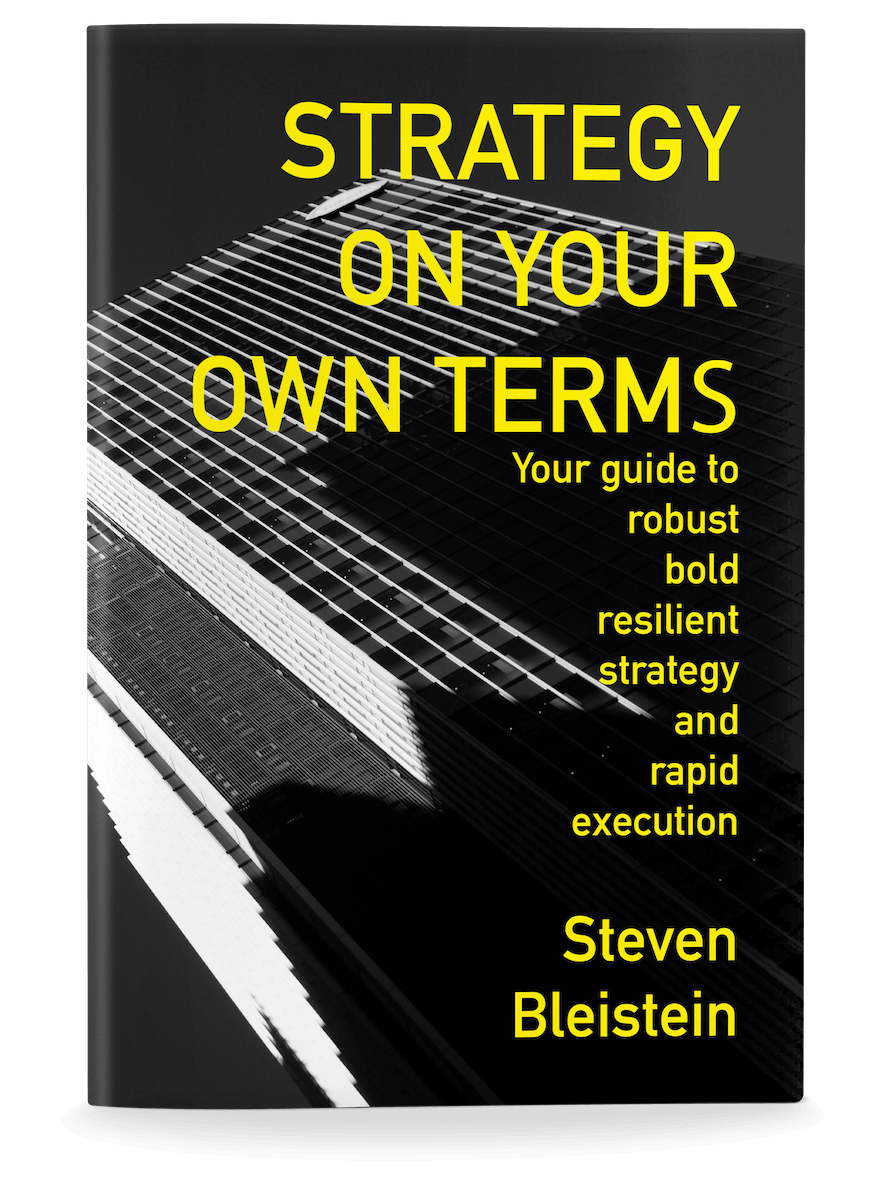
Steve’s New Book: Strategy on Your Own Terms
 Japanese
  English