

>> Click here to listen to this episode
Prefer to listen to the podcast version of this article? Click above to listen in on my Growth Zone podcast.
Last week I presented some of the most provocative ideas from my book Rapid Culture Change at my CEO Roundtable here in Tokyo. The talk opens with a trick: a list of dysfunctions that sound unmistakably Japanese — until you learn they describe a French utility. It’s a setup designed to get a room full of experienced Japan hands to catch themselves mid-assumption. What followed was forty-five minutes of pushback, war stories, and at least one direct challenge to the title of my own book.
Here’s what the room actually wrestled with.
The Talk: Three Tactics, One Premise
Culture isn’t your nationality, your headcount, or your industry. It’s shared beliefs that shape norms of behavior — and you can’t see belief, only behavior. So the diagnostic is simple: what gets rewarded, what gets penalized, and what gets treated with indifference. Three tactics carried the talk:
TACTIC 1 — Impose behavior change first.
- Changing beliefs before behavior means arguing about what will work. Changing behavior first means people get to experience what works. Nothing changes belief faster than real success.
- You cannot compel someone to believe something. You can require someone to do something.
- The case in point: a bio-friendly hair products company deeply committed to selling through distributors — a model that had outlived its usefulness. The CEO didn’t try to win hearts and minds. He required direct sales, gave people a year of cover on results while they learned it, and let the wins do the persuading. Resistance flipped to enthusiasm once the new behavior started paying off.
TACTIC 2 — Establish principles, eschew values.
- Values tell you what and why. Principles tell you how and when. “Boldness” as a value is a poster. “I will never fire anyone for trying something bold that didn’t work, but I will fire for inaction” is a principle — testable, and useless to ignore.
TACTIC 3 — Adhere ruthlessly to your own company culture.
- Cultural sensitivity is passive — you adapt to fit in. Cultural sense-making is active — you act on what you actually believe is right. The case: a French CEO in Japan who nearly passed over his most qualified successor because she was a woman, on the advice of a self-styled Japanese culture expert. Asked whether he’d make that call in France, the answer was an immediate no. He promoted her. She doubled the company’s profit.
Closing line for the room: You either make your culture, or the culture of others makes you.
The Discussion: Where the Room Pushed Back
The talk landed, but the title took the first hit — and the conversation only got more interesting from there. Five threads dominated.
1. “Rapid” and Japan — a contradiction in terms?
- The most direct challenge came early: culturally, Japan is understood to move slowly. What business does a book on rapid culture change have claiming otherwise?
- The response leaned on history, not opinion: Japan went from a feudal society disrupted by Commodore Perry’s arrival in 1853 to defeating the Russian navy at Port Arthur by 1904 — fifty years from closed feudal state to major industrial and military power. Less than twenty years after being flattened at the end of World War II, Japan had the world’s second-largest economy, the fastest train on earth, and was hosting the Tokyo Olympics. That’s not a slow country. Several in the room added their own evidence: multinationals that deliberately base product R&D in Japan specifically because the market adopts new things fast, and Japan’s advancing maglev program, where Germany’s effort stalled.
- The sharper distinction, raised by an engineer in the room: it isn’t that Japan is slow — it’s that Japanese R&D tends to be engineer-driven rather than marketing-driven, which changes the shape and pacing of innovation, not its existence.
2. Two speeds, one outcome
- A French-Japanese contrast surfaced repeatedly, credited at one point to a former Japanese prime minister: the French are quick to decide but poor at sustaining the decision; the Japanese are slow to decide but, once decided, execute with total follow-through. One version of this, attributed to Carlos Ghosn: French teams make a mess and spend six months cleaning it up; Japanese teams appear to do nothing for three months, then execute flawlessly and finish on the same six-month clock.
- A joint-venture story made the mechanism concrete: a French partner, impatient with a Japanese partner’s methodical, step-mapped preparation, ended up being the one who actually missed a delivery deadline — the “slow” side was simply following a process it had already committed to, in writing, in the meeting minutes.
- The reframe that won the room: what looks like a “decision” differs by culture. In Japan, deciding to look into something is itself the first decision — followed by enough preparation to find out, cheaply, whether it will actually work, and to quietly stop if it won’t. Elsewhere, the bold public announcement comes first, and the quiet, trust-eroding walk-back comes three months later once reality intrudes.
3. The “extra loop” — real friction or a convenient excuse?
- A leader with over a decade in Japan, having also worked across Singapore and China, offered a more skeptical read: whatever the tactics, Japan requires “one or two extra loops” to get the same result — not because the tactics are wrong, but because imposing behavior change without enough groundwork here tends to produce quiet non-compliance rather than open resistance.
- That drew immediate pushback in the room: isn’t “Japan is different” exactly the kind of claim the talk had just spent fifteen minutes dismantling? The answer split the difference — it’s not that everything requires different treatment, but that how change gets advocated for is a genuine, specific feature of Japanese business culture, one that doesn’t disappear just because you’ve decided to move fast.
- A useful proportionality point followed: the gap between the careful, deliberate approach and a faster one matters most on high-risk decisions. On low-risk ones, applying the same caution across the board is simply wasted time — the risk should calibrate the process, not the culture.
4. Nemawashi is not buy-in
- The most useful distinction of the session, and one that mapped directly onto Tactic 1: you can and should still do nemawashi — the quiet, individual groundwork of informing people and hearing objections before a decision goes public — without needing their buy-in to move forward. Leaders conflate the two, treat the absence of enthusiastic agreement as a blocker, and stall changes that only ever required consultation, not consensus.
- One story tied this back to mindset directly: a leader in the room described deliberately pushing her team into new behavior — testing, trying, being allowed to fail — as a way of changing belief through experience, exactly the mechanism behind Tactic 1. She named it as effortful, not automatic: people raised inside an education system built around finding the single right answer don’t default to comfort with mistakes. That has to be built, deliberately, by a leader willing to demonstrate it’s safe.
5. Even inside a giant, the leader is the culture
- A story about Nissan closed the loop on the talk’s central claim. Across seven CEOs, the company’s product and engineering culture visibly shifted with each change in leadership — some technically driven, some not, one famous for prioritizing engineering over sales. The size of the company didn’t insulate it from the individual at the top; it just made the shift slower and more visible in hindsight.
- The closing note came from a French advisor who counsels newcomers to Japan: the coaching on business cards and tea ceremony is fine, but it’s not the point. Be polite, mind your manners — and then do business exactly as boldly as you would anywhere else. The language of value, of return, of results, is universal. Excessive caution dressed up as respect isn’t the same thing as respect.
The Takeaway
Strip away the specifics and the room converged on something close to the talk’s own thesis, arrived at the hard way: Japan is not slow, and it is not an exception that requires a different playbook — but it does have its own texture of how decisions get made, and a leader who ignores that texture entirely will get quiet resistance instead of results. The tactics don’t change. The groundwork under them does.
You either make your culture, or the culture of others makes you.
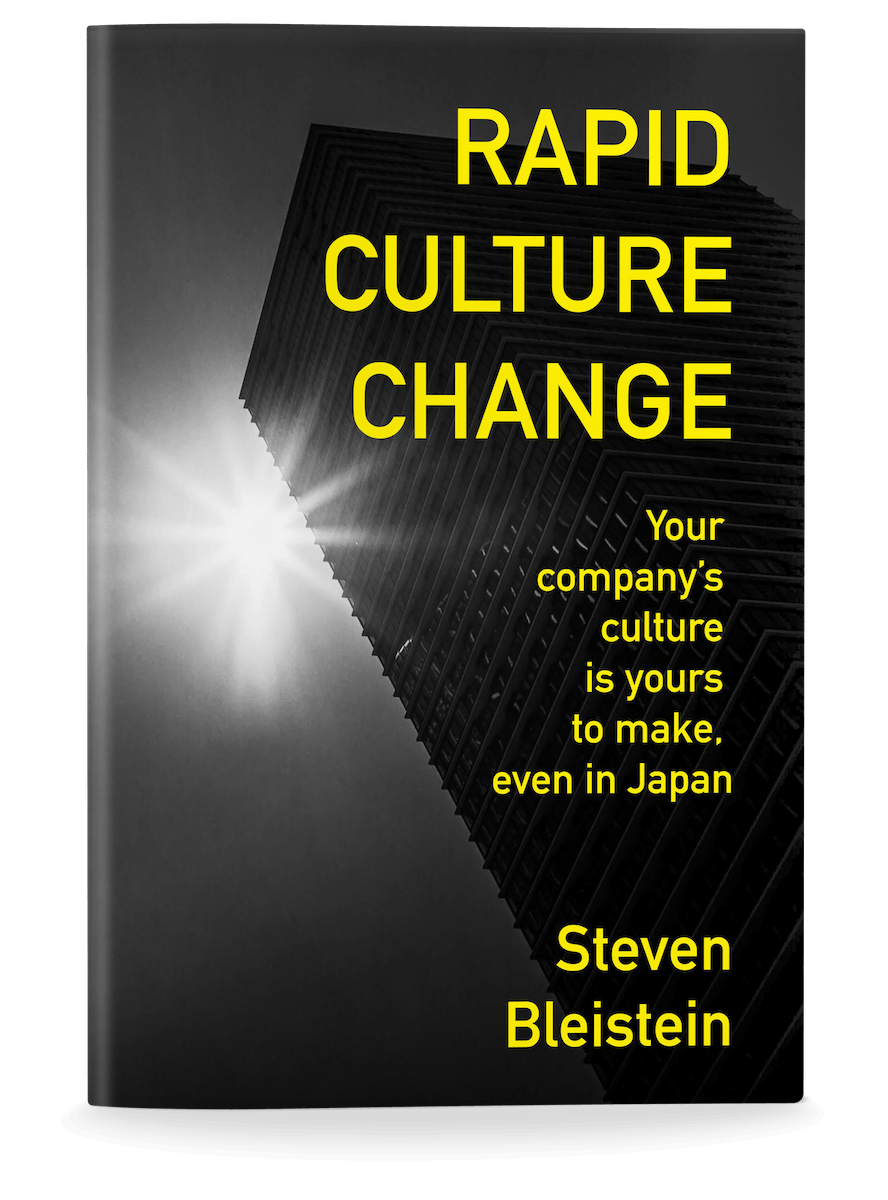
Steve’s New Book: Rapid Culture Change
 English
  Japanese