

>> Click here to listen to this episode
Prefer to listen to the podcast version of this article? Click above to listen in on my Growth Zone podcast.
Japan’s government under Prime Minister Sanae Takaichi just designated 17 priority sectors for long-term protected investment — AI, semiconductors, quantum technology, shipbuilding, defense, and more, reminiscent of the 1980s “Japan Inc.” back when Japan was said to have the world’s only capitalist command economy.
Yet the economic objectives of Japan’s MITI-led dirigisme of the past are not the same as those of Takaichi’s policies of today. What was once a drive for export-driven growth and industrial development in a more or less stable geopolitical environment and a rules-based order of international trade has given way to a less stable world, a decline in American power and perceived dependability, a rise of multipolar geopolitics, and a rupture in the rules-based international trade order.
What Japan is actually doing — whether its policymakers fully realize it or not — is attempting to build strategic resilience into the national economy. Not growth. Not export dominance. Resilience. The capacity to absorb shocks that nobody predicted, keep functioning, and adapt.
And it raises a question every business leader in Japan should be asking right now — not about government policy, but about their own organization.
How resilient is your strategy, really?
The Shocks Were Real
Japan has been hit by compounding disruptions in rapid succession. COVID collapsed supply chains optimized for efficiency rather than redundancy. The US-China technology war forced companies to choose sides. The yen has weakened to levels that erode purchasing power and squeeze import-dependent businesses. Interest rates are rising for the first time in a generation.
None of these were predicted with precision. None appeared in most corporate five-year plans. And none of them are finished.
The Japanese government’s response — protect strategic sectors, guarantee multi-year budget allocations, align industrial policy with national security — is its attempt to institutionalize resilience at the level of the economy. You may agree or disagree with the approach. But the underlying diagnosis is correct.
Optimizing for efficiency in a stable world is rational. That world is gone.
The Assumption Nobody Examined
Here is the uncomfortable truth about most corporate strategy in Japan, and most strategy I encounter globally: it is built on assumptions that nobody has written down.
I have said this in my book Strategy on Your Own Terms, and I will say it again here, because the current environment makes it more urgent than ever.
No strategy means much without a statement of the assumptions upon which it is based. A strategy for a manufacturer must be based on assumptions about supply chains, energy costs, exchange rates, competitive dynamics, regulatory environment — any one of which can fail. The further out the strategy extends, the more likely any given assumption is wrong.
Yet I rarely see a statement of assumptions in strategy documents. What I see instead is a justification of why the strategy is right and a list of tactics. That is a plan. It is not a strategy.
The distinction matters enormously right now. A plan tells you what to do if everything goes as expected. A strategy tells you how to think and act when it doesn’t.
Japan’s businesses — Japanese companies and the Japan operations of foreign multinationals — overwhelmingly built their strategies on an assumption of environmental stability: that supply chains would remain open, that energy would be available, that the yen would stay within a manageable range, that the rules-based trading order would hold. Those assumptions have failed, in several cases simultaneously.
The companies that are navigating the current disruption most effectively are not necessarily the ones with the best supply chain infrastructure. They are the ones whose leaders had already asked: what if our most important assumptions turn out to be wrong? And had prepared contingent responses.
What a Resilient Strategy Actually Looks Like
Strategic resilience is not a plan you write. It is a practice you build into the way the people in your organization think about strategy at every stage.
In Strategy on Your Own Terms, I describe four practices that distinguish strategies which hold under pressure from those that collapse at first contact with reality. All four are relevant now.
Red teaming. At least one internal team regularly plots against your business as a competitor. Over-enthusiasm for a strategy, and insistence on positive thinking and buy-in, can result in being blindsided by foreseeable threats. There is no reason both Kodak and FujiFilm could not have foreseen the rapid demise of film much earlier than they did. You want at least one group inside your business thinking about how to bring it down — before someone outside it does.
Ongoing assumption monitoring. Strategy reviews should include reassessing underlying assumptions, not just progress against KPIs. A critical assumption can turn out to be wrong even if it was correct at the outset. I know a Japanese chemical manufacturer that invested nine figures in a Southeast Asian factory based on the assumption that customers wanted Japanese-standard quality at reduced cost. Customers, it turned out, wanted good-enough quality at lower cost. In every strategy review, KPIs were tracking green — right until the company went to market. There is an axiom here: no strategy ever survives first contact with the market.
Making room for growth. Resilience requires the willingness to cut — not just what is failing, but what is no longer advancing the strategy, even if it is profitable. The companies I have seen weather disruptions best are ones whose leaders had already made hard decisions about what the business is fundamentally for, and what it is not. That prior clarity allows fast action when the environment forces the issue.
Deliberate disruption. A business that is disrupting its own market is far harder to destabilise than one defending a static position. If you are making the future, you are less vulnerable to a future you didn’t make.
The Japan Dimension
In Japan, the normative pressure against naming risks and surfacing assumptions is particularly strong. When a strategy is presented by a senior leader, the social cost of pointing out what might go wrong is high. Concerns remain unspoken. Rough edges are smoothed. What emerges from the consensus process is a document that reflects the median view of what is achievable — which I would call mediocre — rather than the boldest view of what is desired, tested against the most honest assessment of what could go wrong.
Explicitly naming assumptions and their associated risks changes that dynamic. It creates a valid space for concerns to be raised, because the leader has already acknowledged that risks exist. It also makes it much harder to dismiss those concerns as shikata ga nai — without recourse, because this is Japan — when the question on the table is: what is our contingent response should this assumption fail?
The most resilient leaders I know in Japan have made the questioning of assumptions a required step in the strategy process rather than an act of dissent. The result is a consensus that has been genuinely earned — not one that holds only until the first assumption fails.
The Question for Your Business
The Takaichi government has correctly diagnosed a national resilience problem and is responding at the scale available to it. As a business leader, you do not have the option of designating 17 priority sectors and exempting them from normal budget rules. What you have is your organization, your strategy, and the practices you build into how you think and decide.
So here is the diagnostic question I ask every leader whose strategy was built in a more stable world:
Take the strategy currently guiding your business. Can you state the three or four assumptions it depends on? Are they written down anywhere? Who is monitoring them — and what is your contingent response if the most important one turns out to be wrong tomorrow?
If you cannot answer those questions, you do not have a resilient strategy. You have a plan that assumed the world would cooperate.
The world is not cooperating. That is not a reason for paralysis. It is the reason strategy matters more than ever — and the reason it must be built to hold when it doesn’t go as expected.
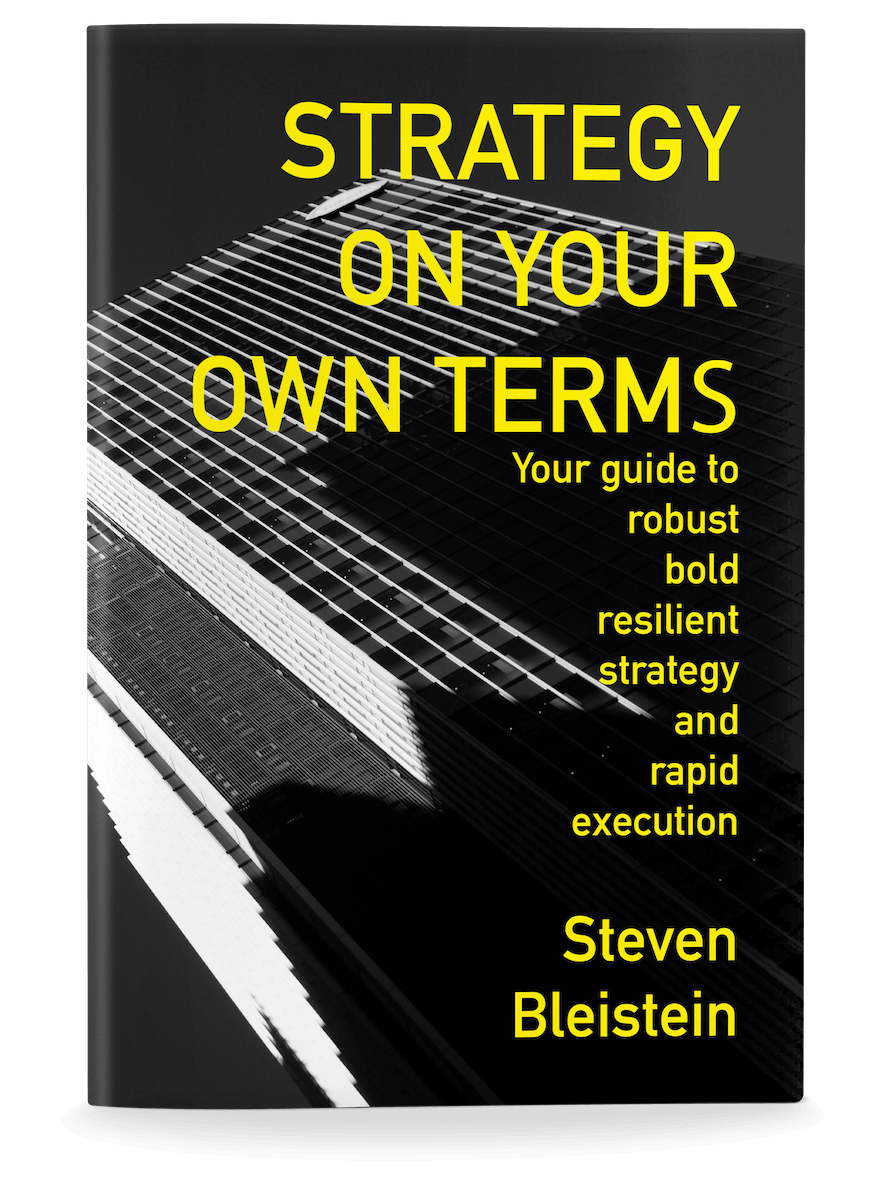
Steve’s New Book: Strategy on Your Own Terms
 English
  Japanese