

>> Click here to listen to this episode
Prefer to listen to the podcast version of this article? Click above to listen in on my Growth Zone podcast.
Last week I presented the ideas from my book Disrupt or Be Disrupted at my CEO Roundtable at The Peninsula Tokyo. The talk opens with a memory: years ago, at an Economist Corporate Network event, a room full of established global businesses spent the entire session on how to avoid being disrupted. I disrupted that discussion myself, on the spot — somewhere in Tokyo, right now, someone is thinking about how to disrupt your business, and the only real question is whether you get there first. What followed was over forty minutes of pushback, live case studies, and one impromptu group exercise to take down Rolex.
Here’s what the room actually wrestled with.
The Talk: Disruption as a Weapon, Not an Accident
Disruption is a strategic, offensive weapon used to dominate a market — brash, unapologetic, never respectful, not even in Japan. It is inseparable from rapid growth: show me an audacious strategy that produced rapid growth, and I’ll show you disruption, recognized as such or not. It’s also charismatic — it repels as much as it attracts, and if it’s unconditional love you’re after, get a dog. Four tactics carried the mechanics of it:
GET IN PEOPLE’S FACES. Godiva Japan’s “Chocolate is no obligation” Valentine’s ad tapped a resentment women had carried for years about giri choco, and doubled the company’s revenue in a shrinking market.
SCREAM IN THE CUSTOMER’S VOICE. Tanaka Megane’s flat-fee eyewear subscription for kids came from radical empathy — feeling, not just observing, a parent’s frustration at replacing broken glasses.
EAT SOMEONE ELSE’S LUNCH. The Peninsula Tokyo, where the talk was delivered, guarantees its best treatment to every guest with no loyalty tiers — a claim competitors built on card programs cannot make.
WEAPONIZE VOLATILITY. Maserati Japan brought cars to customers’ homes during COVID instead of waiting for showroom traffic that wasn’t coming. Never let a good crisis go to waste.
A second set of seven tactics addressed leading a disruptive business:
- Embrace limitations as a force multiplier — Takami’s online-only, no-department-store model.
- Be contemptuous of the status quo — Honda ignoring government directives, Yanai defying apparel-industry norms.
- Exploit unseen innovations already happening on your own front line.
- Borrow others’ innovations, legally — Jobs and the mouse, Dyson and cyclone separation.
- Eliminate bureaucracy, especially tyrannical KPIs.
- Expect to be disrupted in turn — BlackBerry, Blockbuster, and eventually Uniqlo.
- Disrupt yourself before the market does it for you.
Closing line for the room: The best way to defend against being disrupted is to be the disruptor yourself.
The Discussion: Where the Room Pushed Back
1. If disruption is a bet, how do you manage losing it?
The first question in the room went straight at the tension in the talk’s own premise: disruption means taking a risk, so how do you mitigate failure without turning timid? The example on the table was live — a major automotive client’s launch of a fully electric vehicle designed as a disruptive platform, which had gone badly.
The response reframed the comparison entirely. Innovation has a high failure rate by nature — most good ideas don’t work, and that’s simply the cost of doing it. The real risk sits on the other side of the ledger: staying conventional, refusing to challenge the status quo, carries its own high failure rate, just a slower and less visible one. The recommended approach was portfolio thinking — every strategy should carry some disruptive component, sized to the business. For some, the whole strategy is disruptive; for others, a deliberate 10–20% allocation to new bets, treated like the high-risk slice of an investment portfolio.
The room circled back to this later with sharper tactics: redefine failure rather than fear it — one suggestion was to drop the word “failure” altogether — and institutionalize the redefinition with an award for the best idea that didn’t work. If avoiding failure is the goal, you will never innovate.
2. Does disruption have to be fast?
A direct challenge to one of the talk’s central claims — that disruption and rapid growth are two sides of the same coin — arrived via Rolex: growing, wildly exclusive, and not obviously disruptive. The room largely agreed Rolex’s growth looks more like craftsmanship and manufactured scarcity than disruption.
Healthcare supplied the sharper counter-examples. Viagra and the GLP-1 drugs (Ozempic and Wegovy are the same molecule at different doses) both moved fast once approved, after years of slow-moving R&D. The reframe: even where the underlying innovation cycle is long, the disruptive result on arrival can still be rapid — the speed shows up at the point of release, not across the full development timeline. Apple’s retail strategy made a related case: nobody expected a computer brand to move into its own luxury stores rather than through wholesalers, and it took years to play out — iTunes in particular was slow to gain traction and required personal, label-by-label negotiation. Conclusion: “not fast” isn’t the same as “not disruptive enough.” Some disruption simply takes time to compound.
3. Does the whole company need to be disruptive — and how do you get buy-in for it?
One attendee pushed back on scope: disruption sounds valid for an entrepreneur or a single division, but expecting an entire established company to be disruptive felt extreme. The response drew on a client case — a foreign CEO running a major beauty company’s Japan operation kept the cash-cow parts of the business largely unchanged while deliberately pushing other parts to disrupt the market. A recent acquisition of a disruptive challenger brand wasn’t meant to turn the acquired company into the parent — it was meant to make the parent more like the company it acquired. Disruption doesn’t have to be uniform across a business. It has to be somewhere, deliberately, and led.
A second attendee, describing decades of building disruptive businesses in Japan — from the country’s first birth-control-pill launch through a cannabis-derived wellness brand — offered the practical mechanism for getting a resistant organization to accept disruption: the Trojan horse. When his CBD brand was invited into a major airport and department stores, the invitation wasn’t to open a CBD shop — it was to open something food-related. He built one of Japan’s first vegan restaurants with no real intention of selling vegan food; the point was to package CBD inside something the market, and his own organization, could accept, with no cannabis imagery anywhere on the product. Nobody sees a cannabis company. They see a wellness company. Bringing disruption into a large organization, especially in Japan, works better wrapped in something familiar than announced outright.
4. Not every disruption is intentional
The Viagra story returned from a different angle — not as an example of fast-moving healthcare, but of accidental disruption. It began life as a heart-disease trial; the “side effect” participants reported became the product, and the company had to build both a market and a Vatican-level conversation around it — a delegation to Rome, an audience with a famously conservative Pope, who ruled it acceptable within a healthy marriage, which became a genuine PR asset. The lesson generalized: sometimes disruption isn’t planned, it’s recognized — and the organization needs the right culture to grab an unexpected result and run with it.
This connected to a broader framework on where innovation actually comes from: unexpected success (Viagra, 3M’s Post-it, which began as a failed adhesive) and unexpected failure both count as legitimate sources. The practical takeaway for every business in the room: go looking for your own unexpected successes and failures, and ask what you’re doing with them.
5. Japan isn’t risk-averse — it’s under-informed about risk
A sustained argument ran through the middle of the session that Japanese caution is frequently misread. The counter-case: Japanese speakers have far more granular linguistic gradations for expressing uncertainty than most Western languages — the capacity to gauge risk is there; what’s typically missing is the communication of risk levels. Given a clear range of what’s known, unknown, and what to prepare for, resistance drops. What looks like risk aversion is often just insufficiently de-risked communication.
A related point complicated the generational read on this: the assumption that younger staff want to innovate and older staff resist it holds up everywhere, not just in Japan, and isn’t absolute in either direction. The more useful response was structural rather than generational — carve out a small team with an explicit mandate to innovate and disrupt, let them take the early risk, and use their visible wins to bring the rest of the organization along.
On getting buy-in without stalling, the sharpest distinction of the session separated nemawashi from consensus: doing the quiet groundwork of informing people and hearing their objections ahead of a decision does not require securing their enthusiastic agreement before moving. Leaders who wait for buy-in rather than settling for consultation stall changes that never needed unanimous support in the first place. One leader in the room described this in practice — deliberately pushing her team into trying and failing as the way to change belief through direct experience — and named the effort involved: people educated to find the single right answer don’t arrive comfortable with mistakes. A leader has to build that comfort on purpose.
The self-skepticism tactic tied it together: instead of asking a team for a “yes” on a risky idea, ask for help validating whether it works or not — success becomes the validation itself, not a guaranteed outcome. The framing traced back to a PhD advisor’s advice on thesis research: a negative result isn’t a failure, it’s still a contribution, as long as it’s validated properly.
6. The group exercise: how would you disrupt Rolex?
The session turned into a live case study. Suggestions ranged from the self-defeating (a Swatch collaboration) to the structural: kill Rolex’s wholesale distribution network entirely, since brand control depends on it. One attendee pointed to Audemars Piguet as an existing example of disruption through service rather than product — private, membership-gated boutiques where owning the watch doesn’t guarantee entry, turning the brand into something closer to a private club.
Applying “scream in the customer’s voice” to Rolex surfaced the real frustration in the room: customers willing to pay full price still can’t get the watch they want, off a waiting list, on demand — “give me my damn watch.” One counter-angle mirrored the Godiva tactic directly: label Rolex’s own broad popularity as its vulnerability — everyone has one, so wearing one no longer signals anything — the same move Godiva made against giri choco, turning ubiquity itself into the target. A parallel case, Baccarat’s pandemic-era “ienomi kirakira” campaign, showed the same eat-someone’s-lunch mechanic working in an unglamorous category: reframing home drinkware as a small, local, culturally specific luxury during COVID lockdowns, and pulling in customers who’d never have bought Baccarat otherwise.
7. The next book: facing disruption, not just starting it
One closing suggestion landed cleanly: the natural sequel isn’t about instigating disruption, it’s about facing it — specifically, facing AI, which every business in the room expects to be seriously affected by, faster than most expect. A useful correction followed immediately: AI itself won’t kill anyone’s business; a competitor who uses AI faster will. The response was enthusiastic and specific — both a book and a dedicated Roundtable on AI and innovation are now on the list, framed around a real gap in the existing material. Disrupt or Be Disrupted is about preventative action, taken before disruption hits. What happens when a business gets blindsided instead, and has to recover? That’s a different book.
8. Comfort with ambiguity — a universal leadership trait, not a Japanese quirk
The idea that Japan is uniquely averse to disruption drew a direct correction: France is comparably bureaucratic and change-resistant — this is a mindset to cultivate in any culture, not a national trait. The same attendee flagged a genuine Japanese advantage, though: comfort with ambiguity, where many Western languages and cultures are built for precision and discomfort with the unclear.
This reframed risk aversion once more, tying back to an idea from my first book, Rapid Organizational Change: what reads as risk aversion among Japanese staff is better understood as an acute sense of personal responsibility — leverage that sense rather than fight it, and the caution becomes an asset instead of an obstacle. The distinction that closed the session, raised from the floor: isn’t that exactly the line between management and leadership? Management protects stability and predictability; leadership requires being comfortable disrupting them. When assessing anyone’s leadership readiness, comfort with ambiguity is one of the first things worth testing for.
The Takeaway
Strip away the specific tactics and case studies, and the room’s real debate was never whether to disrupt — nobody at the table defended pure conventionality. It was about calibration: how much risk, how fast, how packaged, and for whom. Rolex proved the exception that tests the rule. The automotive failure proved the cost of getting the calibration wrong. The Trojan horse and nemawashi threads both answered the same underlying question — how do you bring a resistant organization along without asking for permission you don’t need.
The best way to defend against being disrupted is to be the disruptor yourself.
Steve's New Video on YouTube
DISRUPT OR BE DISRUPTED: CEO Roundtable Discussion Summary
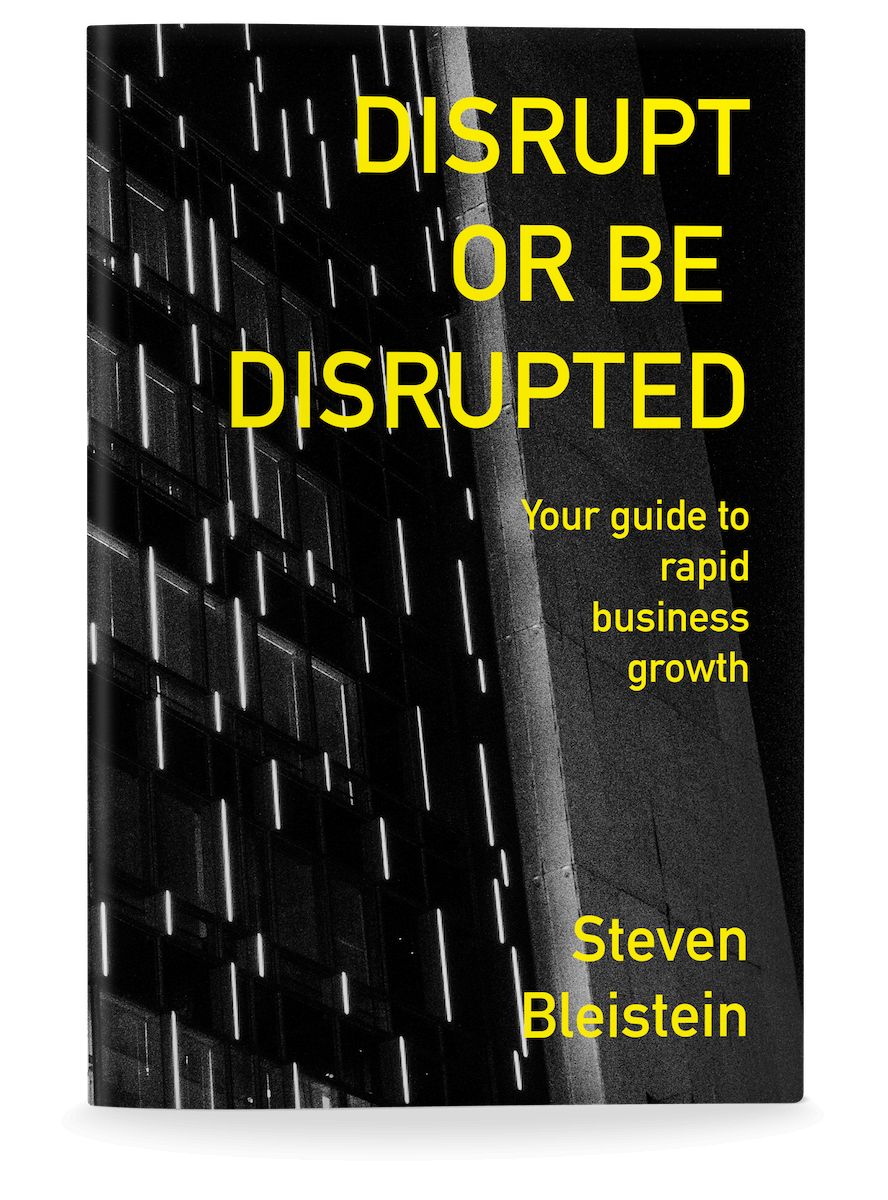
Steve’s New Book: Disrupt or Be Disrupted
 English
  Japanese