
>> Click here to listen to this episode
Prefer to listen to the podcast version of this article? Click above to listen in on my Growth Zone podcast.
Citigroup is growing its Tokyo investment banking team by 30 percent. Daiwa Securities is rebuilding its global M&A staff from 640 bankers to 900. Goldman Sachs has committed 800 billion yen — over 5 billion dollars — to Japan’s mid-cap market over the next decade. Every one of these firms is chasing the same thing: a Japanese M&A market that hit 350 billion dollars in 2025, the highest since anyone started counting in 1998.
If you’re a foreign executive running a business in Japan, you probably read that kind of news the way most people do. Interesting. Background noise. Somebody else’s deal.
It isn’t. And the reason it isn’t has nothing to do with M&A. It has to do with strategy.
The assumption nobody writes down
In Strategy on Your Own Terms, I make the case that no strategy means much without an explicit statement of the assumptions it depends on, and that those assumptions have a half-life. The chances of any one of them turning out to be wrong only grow the further you project forward. I also argue that an assumption is simply the mirror image of a risk — restate it as a “what if,” and you have something you can actually monitor and manage.
Ask any foreign executive in Japan what their strategy assumes about their key suppliers, distributors, or joint venture partners, and you’ll get a blank look, the same blank look I describe getting when I ask managers for their strategic assumptions generally. Nobody has written it down. But the assumption is there, doing quiet work underneath every plan: this relationship will keep behaving the way it always has.
That assumption has never been shakier. Governance reform has spent the last decade rewiring how Japanese boards think about ownership. Hostile bids, once close to unthinkable, are now a recognized playbook. Private equity isn’t circling the edges of the market anymore — it’s structuring the biggest deals in it. None of that shows up on a vendor scorecard. It shows up as a press release, on the day it’s already too late to do anything but react.
Six companies that had no idea they were “in play” — until everyone did
The pattern is visible if you know where to look, and in every case, there was lead time that went unread.
Fujitec. EQT’s 2.7 billion dollar tender offer followed a prolonged governance dispute — a dispute that was public and ongoing well before the offer landed. Anyone monitoring Fujitec as a counterparty, rather than just as a maintenance vendor, had months of warning that ownership was contested.
Seven & i Holdings. Alimentation Couche-Tard’s 47 billion dollar bid was ultimately withdrawn, but the pursuit itself was telegraphed by prior stake-building and public interest long before the formal offer. The deal not closing doesn’t mean the signal wasn’t real — it means the company remains a live target, and anyone who dismissed the story once it was withdrawn missed that the underlying exposure never went away.
Fuji Soft. A bidding war between KKR and Bain Capital didn’t erupt from nowhere; it followed a period of visible activist pressure on the company’s valuation and capital structure — exactly the kind of signal a competitor-facing monitoring function exists to catch.
Hogy Medical. Carlyle’s offer is one data point in a broader, trackable pattern of private equity moving into healthcare-adjacent sectors in Japan. Anyone watching sector-level PE activity, not just individual companies, would have seen this sector heating up before this specific deal.
T&K Toka. Bain Capital’s “white knight” intervention against a hostile bid from Dalton Group is a textbook case of a company under sustained pressure long before the acquisition attempt became public.
Roland DG. Brother Industries’ move to block a management buyout reveals that even the ownership resolution process itself — not just the initial threat — is now contested and requires tracking through to the end.
None of these six companies asked to be “in play.” But in every case, the signals existed before the outcome did. The companies and counterparties that got blindsided weren’t blindsided by the deal. They were blindsided because nobody was watching for it.
The Japan dimension: why this risk goes unspoken
In Strategy on Your Own Terms, I write about how Japan’s consensus-building process can suppress the naming of risks that everyone privately senses but nobody wants to be the one to raise. The same dynamic applies here, often more strongly, because raising the question “what if our supplier’s ownership changes hands” can feel like an accusation against a trusted, long-standing relationship — as if you’re implying instability where none has been shown.
But the fix is the same one I recommend for strategy reviews generally: name the assumption explicitly, and the conversation stops being about doubting the relationship and starts being about managing a shared risk. A leader who says outright, “we’re assuming this partnership stays stable — let’s talk about what we’d do if it didn’t,” creates space for a candid conversation that vague unease never will.
Building the watch function — not a one-time audit
This isn’t a project. It’s a standing capability, structured the same way I recommend building any assumption-monitoring practice into a strategy review.
State the assumption. For each of your top ten to fifteen Japanese counterparties — suppliers, distributors, JV partners, landlords, key resellers — write down, explicitly, what you’re assuming about their ownership and priorities staying stable.
Describe how you’ll validate it. Who is tracking activist filings, tender offer announcements, and board composition changes for each counterparty? How often? This is the piece most foreign executives skip entirely — not because it’s hard, but because nobody assigned it to anyone.
Restate the assumption as a risk. For each counterparty: what if this assumption turns out to be wrong? What would a change in ownership mean for pricing, priorities, or continuity of the relationship?
Choose your response. You have the same four options for any strategic risk:
- Take preventative action. Diversify the relationship, deepen ties with multiple stakeholders inside the counterparty, build alternative sourcing.
- Prepare contingent action. Have a plan ready if ownership changes hands tomorrow.
- Do both 1 and 2.
- Decide, deliberately, that the exposure is acceptable and live with it. What you cannot do is the thing most companies are doing now, which is none of the above, by default, without ever having made the choice.
Review on the pace of the market, not the pace of your fiscal year. At 350 billion dollars in annual deal volume and accelerating, an annual review cycle is already too slow.
The difference is lead time, not luck
Those banks aren’t hiring because they expect deal flow to slow down. They’re positioning for exactly what’s described above — more targets, more transitions, more counterparties whose ownership will look different a year from now than it does today.
The companies that get blindsided over the next two years won’t be the ones whose supplier got acquired. Plenty of stable, well-run companies will change hands, and that’s not a failure of anyone’s strategy. The real difference will be between the companies that had two months’ warning and time to plan, and the companies that had none — because they never wrote down the assumption in the first place, let alone assigned someone to watch it.
That’s not a governance problem. It’s an intelligence gap. And unlike most of what shows up in the M&A headlines, it’s entirely within your control to close.
Steve's New Video on YouTube
You Don’t Have a Governance Problem With Your Japanese Partners — You Have an Intelligence Gap
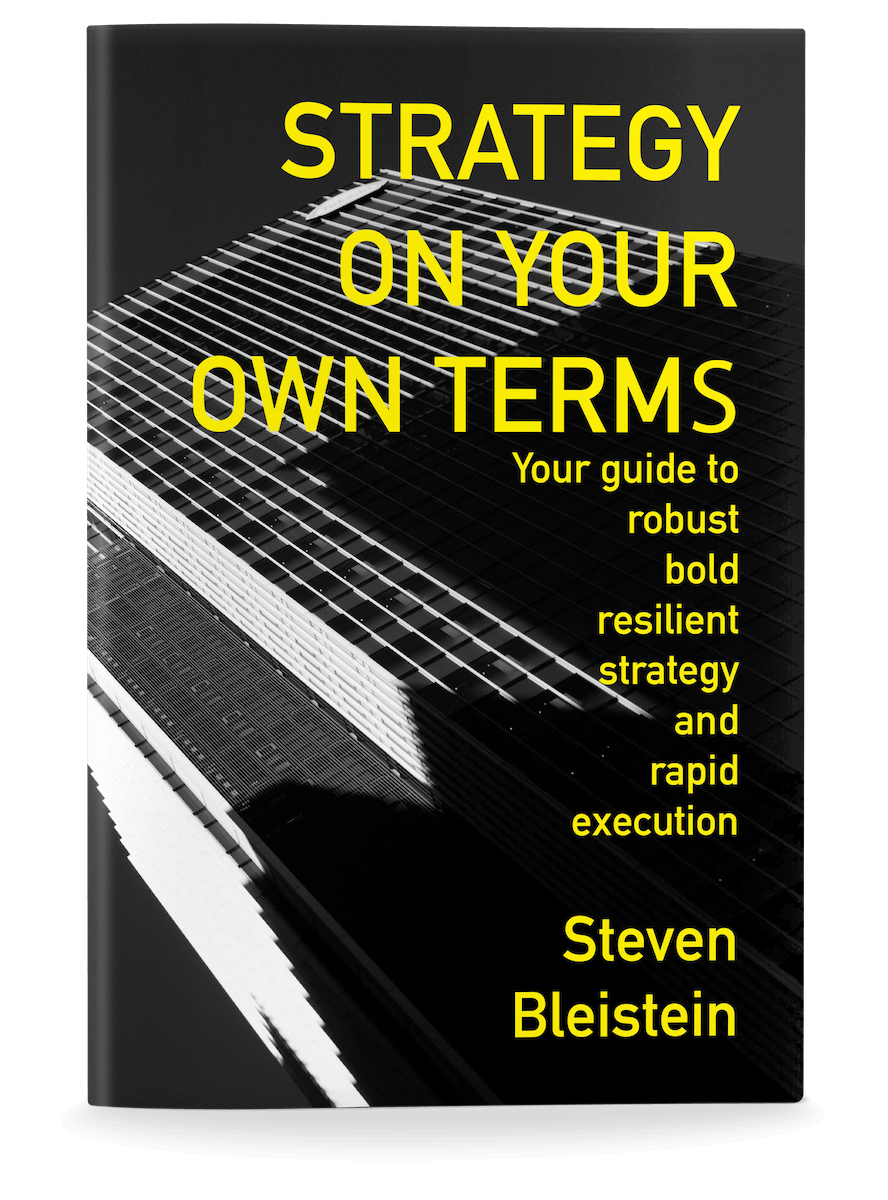
Steve’s New Book: Strategy on Your Own Terms
 English
 Japanese