

>> Click here to listen to this episode
Prefer to listen to the podcast version of this article? Click above to listen in on my Growth Zone podcast.
Last week, I presented some of the most provocative concepts from my recent book Dauntless Leadership at my CEO Roundtable hosted at The Peninsula Tokyo. Many leadership talks end with applause and a forgotten handout. This one ended with seventeen CEOs lively debating about HR, Carlos Ghosn, and whether Japan can innovate at speed – the kind of discussion worth having.
Here’s what the room actually wrestled with.
The Talk: Eight Statements, One Discipline
Dauntless leadership isn’t a personality trait. It’s a discipline — the discipline to act on what you already know, instead of waiting for the right moment, for buy-in, for permission you already have. Eight provocations carried the talk:
STATEMENT 1
“You’re not there to be liked, even though you are most likely likable.”
- Being liked is fine. Needing to be liked is fatal. The manager who delays a hard call to stay popular ends up disliked by everyone — the top performers leave, the laggards stay comfortable. You’re there to get results. The rest follows.
STATEMENT 2
“Buy-in is optional. Professionalism is a must.”
- Waiting for unanimous agreement is waiting for something that may never arrive. Professionals execute decisions they don’t fully believe in — that’s the job. Ignore those who lack the professionalism to support a decision they disagree with; let them buy in on their own time, if they buy in at all.
STATEMENT 3
“You cannot give ownership. Ownership must be taken.”
- You can no more give someone ownership than give them will. The tell: managers with real ownership describe what they themselves are doing; managers without it describe what someone else needs to change first. The content of the complaint doesn’t matter — the orientation does.
STATEMENT 4
“You cannot motivate people. People must motivate themselves.”
- Stop trying to motivate the unmotivated. Clear the way, show the way, then let go. Their lack of motivation isn’t your responsibility — but supporting the people who motivate themselves is. Spend your energy there.
STATEMENT 5
“You have the right to make mistakes.”
- A postponed decision is still a decision — and rarely the optimal one. Every good call has dissenters. Listen to them, then decide anyway. You’ll be held accountable, not your staff. That’s the job, and it’s your right.
STATEMENT 6
“Show me someone who never fails, and I’ll show you someone who never learns.”
- Posed to an HR director as a hiring riddle, the “safe” answer — hire the one who’s never failed — is the wrong one. Failure on the road to success is normal, not disqualifying. The flip side matters just as much: hold people accountable for inaction, not just for failure.
STATEMENT 7
“You must institutionalize confrontation.”
- No healthy organization is in harmony. Constructive disharmony is the goal — raise conflict, don’t sit on it; resolve it through an agreed process; never blame, only describe impact; make commitments public. Eschew harmony. It’s a red herring.
STATEMENT 8
“No one is shooting at you.”
- Most of us in business have never faced a genuine life-or-death stake — yet plenty of managers operate as if someone were. Habitual tentativeness retards learning. Act with boldness. Teach your people to do the same.
Closing line for the room: Dauntless leadership isn’t a personality trait. It’s a discipline — ownership, boldness, accountability, and a bench of leaders under you who can do the same. Pick one thing you’ve been waiting on. Don’t wait. Act.
The Discussion: Where the Room Pushed Back
The talk landed. The discussion is where it got tested. Five threads dominated:
1. HR is the avatar for everything wrong with deferred leadership
- The room didn’t need convincing that HR is often an impediment rather than a help. One leader called it archaic — a function still operating on a forty-year-old design while leaders absorb the pressure it generates.
- The sharper point, surfaced by another leader and seconded around the table: the problem isn’t HR, it’s the leadership vacuum that lets HR define itself. Demand business outcomes from your HR director the way you’d demand them from a sales director — and the antiquated-HR conversation disappears, because you’re now the one setting the terms.
- The most pointed anecdote: an HR director asking the speaker to coach a sales director, unable to say what business outcome the coaching was supposed to produce. That’s not an HR failure. That’s a leadership failure to assign HR a mandate.
2. Does “dauntless” survive contact with Japan?
- The strongest challenge: Japan runs on nemawashi (根回し — private consensus-building to make a decision in advance of public discussion) and middle-out consensus, not top-down boldness. Push a bold position without lower-level buy-in and the system passively resists — it slows, it stalls, it quietly kills the idea at the level below where it was decided.
- The counter, offered from direct experience inside Japan: kaizen and dauntlessness aren’t opposites. Several leaders in the room pointed to conservative Japanese companies running visibly bold change agendas — proof the two coexist when leadership intends it.
- The more honest answer split the difference: change happens in Japan, but it can take two to three times longer than in other markets — less a cultural wall than a cultural toll. The deeper diagnosis: passive resistance shows up when the people expected to execute the change were never made part of deciding it.
- One reframe mattered most: you are nearly powerless to change Japanese culture, but entirely capable of building a company culture that diverges sharply from it. Fast Retailing, SoftBank, Google versus Sears — distinct cultures inside the same national or competitive backdrop, set deliberately by the leader at the top, not inherited from the environment.
3. Outlier or not, it’s still your choice
- Naming Masayoshi Son and Tadashi Yanai as proof that boldness works in Japan drew a fair objection: those two are outliers among tens of thousands of Japanese companies.
- True — and irrelevant. Excellent leaders and excellent companies are outliers by definition; that’s what excellence is. Being in the middle of the distribution isn’t shameful — plenty of mid-pack companies have thrived for seventy, eighty, ninety years and delivered real value. But “middle” and “outlier” aren’t a verdict on you. They’re a choice you make.
4. Process is situational. Principles are not.
- A recurring tension: frameworks that work in one market, one company size, one ownership structure don’t transplant cleanly elsewhere. Calibration matters — a 3,000-person organization and a 55-person team don’t run the same playbook.
- The resolution, and arguably the most important idea of the session: processes are fungible and contingent on the situation — but principles are constant. The institutionalized-confrontation framework, for instance, will look different in execution depending on company and culture, but the underlying principles hold in any configuration. Stop arguing about process. Get aligned on principle first.
- On vocabulary: even a word as loaded as “failure” carries baggage that varies by culture — the same idea, expressed differently, still serves the principle.
5. Moral injury: the discussion that didn’t get enough time
- A late, weighty digression distinguished moral injury from ordinary burnout: not fatigue, but the damage done when leaders discover — after committing — that the role they signed up for and the role they actually hold are not the same thing. The systemic betrayal cuts deeper than overwork.
- It surfaces in corporate contexts as much as military ones: the executive ordered to cut a thousand jobs for purely financial reasons; the employee who learns their actual mandate was to automate themselves out of a job.
- The room flagged this, half-joking and half-serious, as something baked into the job description of leadership itself — which is precisely why it deserves a full session of its own. Flagged for a future roundtable.
The Takeaway
Strip away the specifics and one thread runs through every argument in the room: leaders don’t lack good frameworks. They lack the willingness to act on the ones they already have. HR’s mandate, Japan’s pace, your place in the distribution, the process you should run — all of it is downstream of a decision only you can make.
Pick one thing you’ve been waiting on. Don’t wait. Act.
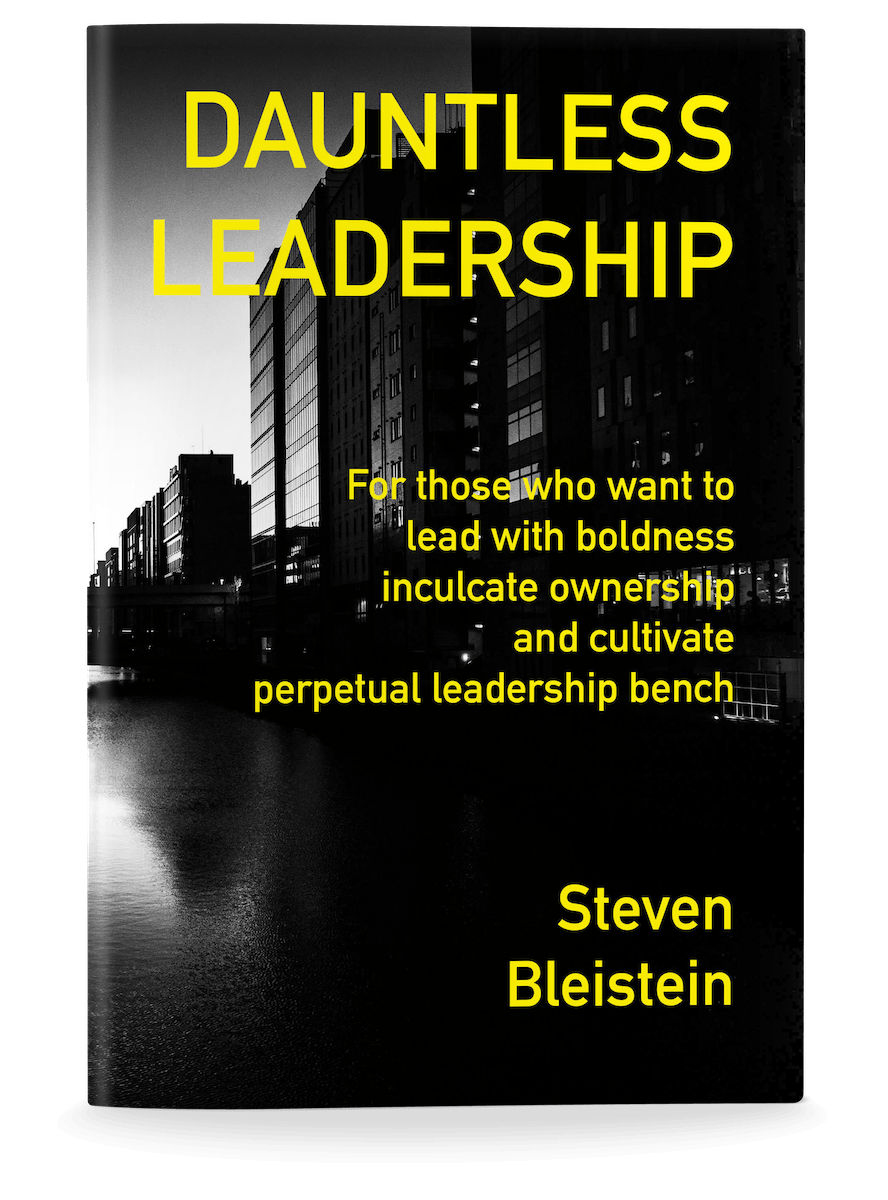
Steve’s New Book: Dauntless Leadership
 English
  Japanese