

Toshifumi Suzuki, the founder of Seven-Eleven Japan and the man most responsible for turning the konbini into a cornerstone of daily Japanese life, died on May 18 at the age of 93. He was one of the most consequential retail disruptors of the twentieth century. His career is also one of the most instructive business stories you will ever read — not because of how he rose, but because of how it ended.
I want to use his passing as an opportunity to talk about something I address directly in both *Disrupt or Be Disrupted* and *Charismatic Disruption*: the dangerous moment when a disruptor forgets that disruption is not a destination. It is a posture. And the moment you stop holding it, someone else picks it up.
The Disruption That Changed Everything
In 1973, Suzuki was an executive at Ito-Yokado, a Japanese retailer. Japan’s market was pivoting aggressively toward large American-style supermarkets. Analysts dismissed small neighbourhood stores as obsolete. The conventional wisdom was clear: scale wins.
Suzuki ignored it. He had seen a 7-Eleven store during a US visit and recognised something that nobody else in his company seemed to see — that the direction of Japanese retail was wrong. He fought the institutional opposition inside his own organisation, partnered with Southland Corp to license the 7-Eleven brand, and opened Japan’s first 24-hour convenience store in Tokyo’s Toyosu district in 1974.
What he built was genuinely charismatic disruption in its purest form. He did not simply copy an American model. He reinvented it. He pioneered data-driven inventory management before that phrase existed, designing systems that tracked what individual neighbourhoods were buying hour by hour and adjusted stock accordingly. He made ready-to-eat meals a premium category. He turned a small corner store into essential public infrastructure — a place where you could pay your utilities, withdraw cash, pick up a parcel, and get a hot meal at three in the morning.
By the time Southland Corp filed for bankruptcy in the early 1990s, Suzuki’s Japanese operation was so far superior to the American original that he orchestrated the rescue and restructuring of the parent company. The student had become the master. In 2005, he consolidated everything into Seven & i Holdings, a global retail conglomerate with 85,000 stores across twenty countries.
This is the Suzuki most obituaries will celebrate. And rightly so.
The Part the Obituaries Get Wrong
But there is a second Suzuki — the one who spent his final years at the helm locked in a boardroom battle with activist investor Dan Loeb, eventually losing a management reshuffle vote and resigning as CEO in 2016.
When he stepped down, Suzuki did not blame the investor community, short-termism, or the ingratitude of boards. He blamed himself. That kind of accountability is rare and admirable. But I want to go a step further and ask the harder question: what actually happened?
In *Disrupt or Be Disrupted*, I argue that the single greatest risk a successful disruptor faces is not competition from outside. It is the internal crystallisation that comes with success. The very systems, structures, and certainties that made the disruption work become the walls that prevent the next one.
Suzuki built an extraordinary organisation. But by the time Loeb arrived, Seven & i Holdings had become a conglomerate that was expanding into supermarkets, department stores, and financial services — none of which were performing at the same level as the konbini core. Suzuki had a vision for where the group should go next. His board disagreed. The disagreement became a crisis.
This is a pattern I have seen in Japan and across global organisations. The leader who disrupted the market develops, over time, a certainty about what comes next that begins to close off the organisation to other possibilities. Disruption, at its origins, is a posture of radical openness — a willingness to see what others cannot and act on it before consensus catches up. But success hardens that posture into conviction. And conviction, unchecked, becomes dogma.
The disruptor stops asking whether the world is changing. They start telling the world what it should look like.
What Charismatic Disruption Actually Requires
In *Charismatic Disruption*, I describe the capacity that separates lasting disruptors from one-generation wonders. It is not strategy, though strategy matters. It is not data, though Suzuki understood data better than almost anyone in global retail. It is the disciplined maintenance of what I call disruptive curiosity — the ability to keep questioning your own model even when it is working.
Suzuki had this in abundance in the 1970s and 1980s. The question his story raises is why it becomes so hard to sustain it as the organisation grows and succeeds.
Part of the answer is structural. As a disruptive idea scales into an institution, the people who were most comfortable with uncertainty in the early stages get replaced — naturally, gradually — by people who are better at operating certainty. That is not a failure. It is the logic of growth. But it creates a dangerous gap between the leader’s disruptive instincts and the organisation’s capacity to act on them.
Part of the answer is psychological. Success is a powerful anesthetic. It reduces the urgency that drove the original disruption. And in Japan in particular — where Suzuki built a company that was not just commercially dominant but genuinely woven into the fabric of daily life — success had an almost mythological quality. It is very difficult to question a model that feels like infrastructure.
And part of the answer is that Suzuki’s exit was not driven by the market. Seven-Eleven Japan remains the world’s most capable convenience store operator. His disruption held. What failed was the next disruption — the one that would have repositioned a mature conglomerate for the next generation of growth. That is a different challenge from building a new business, and it requires a different set of leadership capabilities.
The Question for Every Leader
I do not tell this story to diminish Toshifumi Suzuki. His achievement is extraordinary by any standard. I tell it because his career contains the exact lesson that *Disrupt or Be Disrupted* is built around.
Disruption is not something you do once and own forever. It is something you must do continuously — to your competitors, yes, but also, and more importantly, to yourself.
The foreign executives I work with in Japan face a version of this challenge constantly. They come in with disruptive intent — a new model, a new way of doing business, a new expectation of how things can work. Many of them succeed. They build something that works. And then, quietly, over years, the organisation they built starts to look more and more like the organisations they came here to disrupt. The processes calcify. The assumptions go unquestioned. The original disruptive edge gets managed away in the name of consistency and scale.
Suzuki’s story is a reminder that this is not a character flaw. It is an organisational gravity. It pulls on every institution, every leader, every strategy that has ever worked.
The only defence against it is to build disruption into the structure of how you lead — not as a one-time intervention, but as a standing practice. To make it normal, required, and institutionally safe to ask the question that Suzuki was asking in the 1970s: what if the conventional wisdom is wrong, and we are the ones to prove it?
He asked that question once. He answered it brilliantly. His life’s work was the proof.
The question for every leader reading this is not whether Suzuki was great. He was. The question is: who is asking that question inside your organisation right now? And what happens when they do?
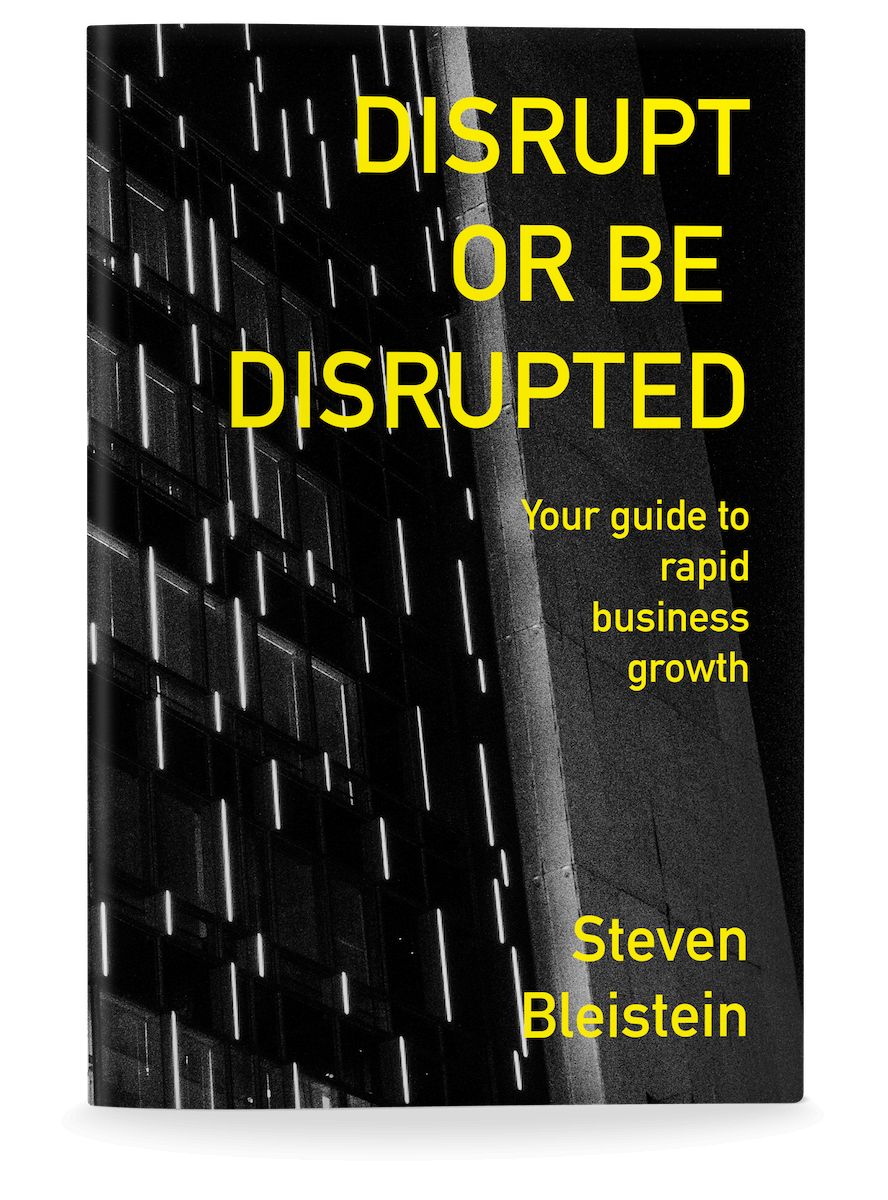
Steve’s New Book: Disrupt or Be Disrupted
 English
  Japanese