

Japan’s ruling Liberal Democratic Party is moving to raise the thresholds required for activist shareholders to propose resolutions at company annual general meetings. If you missed the CNBC report from April 27th, here is what it means in plain terms: Japan is erecting a wall around underperforming companies and calling it governance reform.
This is not a technical adjustment to securities law. This is protection — for incumbent boards, for mediocre capital allocation, for the status quo that suits the people already comfortable inside it. And it reverses years of momentum that was, slowly but unmistakably, changing something real.
Let me be direct about what is being dismantled here.
What Shareholder Activism Was Actually Doing
When the Tokyo Stock Exchange launched its 2023 push demanding that companies with price-to-book ratios below 1.0 explain their capital allocation plans or face consequences, it created something Japan’s corporate governance had rarely experienced: unavoidable accountability.
Japanese companies had been sitting on mountains of cross-shareholdings, surplus cash, and underperforming divisions for decades, insulated from any serious challenge to explain themselves. Activist shareholders — domestic and foreign — broke that insulation. They could put resolutions on the table, force boards to respond publicly, and make it costly to keep doing nothing.
Were the activists always right? No. Did some pursue short-term interests at the expense of long-term strategy? Of course. But the mechanism worked. Capital allocation improved. Boards became less ornamental. Japanese companies were forced to confront, in public, things they had been politely avoiding for years.
That mechanism is now being shut down.
This Is Precisely Why Constructive Disharmony Matters
I have written for years about a principle I call constructive disharmony — the idea that no healthy organization is ever truly in harmony, and that the tension arising from challenge and confrontation is what produces real progress. Excessive harmony leads to submerged business problems, missed opportunities, and decisions left unmade because everyone chose to avoid the discomfort of making them.
What shareholder activism introduced into Japan’s corporate landscape was exactly that: constructive disharmony, applied from the outside. It made it socially uncomfortable — and increasingly expensive — for boards to sit on underperforming assets without explanation. The challenge was unwanted. That is precisely what made it effective.
Japan’s government has now decided that this discomfort was a problem to be solved, rather than a mechanism to be preserved.
I have seen the same dynamic play out inside organizations. When a CEO removes accountability for poor performance because it makes people uncomfortable, behavior doesn’t change — it calcifies. When a company eliminates the forum in which managers are required to confront each other across departmental lines, silos don’t dissolve — they harden. Remove the source of external challenge, and people return to what they were already doing, because nothing requires them to do otherwise.
This is what Japan has just done at the macro level.
What This Means If You Are Running a Business Here
If you are a foreign executive leading a business in Japan and you have been watching macro-level governance reform and thinking, “at least the environment is changing around me” — stop. That tailwind is gone.
Actually, let me be more precise: if you were relying on it, you were already making a mistake.
I hear it constantly — executives waiting for Japan to reform itself into the business environment they need. Waiting for boards to become more decisive. Waiting for staff to become more assertive. Waiting for the culture to shift so that bold action becomes easier. I have spent years telling people that this is not a strategy. It is an abdication.
The most persistent version of this thinking is the belief that Japanese organizations are culturally resistant to change. I reject this. What looks like cultural resistance is almost always something else: absent standards, absent accountability, or absent support for people trying to do things differently. It is a management problem, not a cultural one. And it is solvable.
The LDP’s move doesn’t change any of that calculation. If anything, it clarifies it.
What Actually Produces Change Traction
I describe change traction as resting on three pillars: clear standards of performance and behavior, genuine accountability to meet them, and real support to help people succeed. A deficit in any one of these will kill a change initiative — regardless of how much external pressure exists.
External pressure — whether from activist shareholders at the macro level, or from headquarters mandates at the organizational level — is not a substitute for any of these three pillars. It can create urgency. It can provide cover for a leader who wants to act boldly. But it cannot replace the leader’s own willingness to set a standard, hold people to it, and invest seriously in their ability to meet it. Without those three things, change is treated as either an extracurricular activity, an exercise in lip service, or a meat grinder. I have seen all three in Japan and none of them produce results.
Action first, buy-in later. That is how change moves — in Japan and everywhere else. Nothing persuades like real results. The most successful leaders I know do not wait for the environment to become more permissive before they act. They use execution to get buy-in.
And here is what the LDP’s move makes plain, even if that was not its intent: the one external accountability mechanism doing some of this work is being removed. For foreign executives running businesses in Japan, the implication is not despair. It is clarity.
You were always the change agent. You are the only change agent. This just confirms it.
So What Are You Waiting For?
The conversation I keep having with executives in Japan goes like this: they describe an organization that avoids confrontation, a board that equivocates, a culture that prioritizes harmony over results. Then they ask me what they can do about it.
My answer is always the same. Institutionalize confrontation. Set standards that mean something. Apply accountability without exception. Support people genuinely in meeting the bar you have set. Do all of this now — not after the environment becomes more hospitable, because the signal from Tokyo this week is that it will not.
Are you still waiting for Japan to reform itself into the business you want to run?
That was never a strategy.
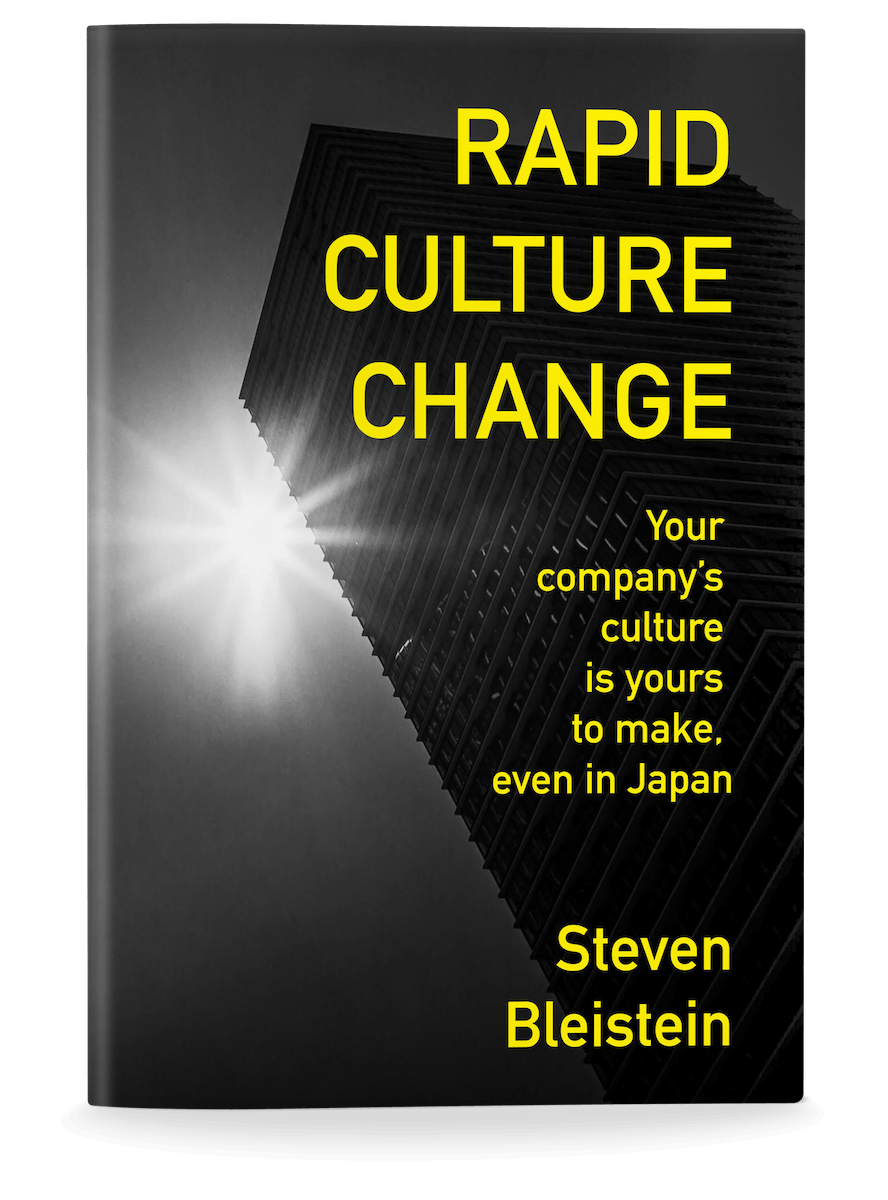
Steve’s New Book: Rapid Culture Change
 English
  Japanese