

I run a monthly, private CEO Roundtable for my best clients and business leaders in the community whom I choose to invite and share the discussion summary with my community. If you are interested in joining us on the live discussion, drop me a line.
Below is the Discussion Summary of my recent CEO Roundtable.
The Nine Provocative Statements
1. Strategy is about creating the future, not predicting it.
Strategy is not forward projection from the present — that is planning. Real strategy starts with a bold vision and works backward. Working backward turns constraints into solvable problems; working forward turns them into excuses.
2. ‘Strategic planning’ is an oxymoron.
Planning and strategy point in opposite directions. A plan tells you what to do when everything goes as expected; a strategy tells you how to think and act when it doesn’t. Plans start from the present and build forward. Strategy starts from the future and builds backward. The moment you begin with current-state analysis, you have already compromised the vision. Apple’s Steve Jobs built the Macintosh, not the Apple IV. Fast Retailing’s Tadashi Yanai built Uniqlo, not a better clothing wholesaler.
3. No strategy survives first contact with the market.
The most important work in strategy is not justifying why it will succeed — it is identifying what could go wrong and building contingencies. A nine-figure (U.S. dollar) factory investment I described turned on an assumption (customers wanted Japanese-quality products at lower cost) that proved wrong on market contact. Every KPI had tracked green right up until that point.
4. Decide which profitable business to cut first in order to make room for growth.
Cutting unprofitable businesses is easy. The harder and more necessary discipline is cutting profitable businesses that no longer fit the strategic direction. You cannot pile new initiatives on old ones and expect to grow. One client cut their profitable auto insurance business — a commodity product — to make room for highly differentiated services. That decision separated real strategy from wishful thinking.
5. Strategy is about the audacious business you want, not the one you think you can reasonably have.
Constraints are real but not disqualifying. Most executives filter ambition through what seems achievable — which is exactly backwards. State the audacious version first, then solve for how to make it real. A retail executive I coached proposed a bold reinvention of her company’s online channel. Many of her ideas were adopted. Audacity is the permission to propose bold ideas without apology.
6. The best strategies always polarize, at least at first.
In Japan especially, normative pressure produces strategies everyone agrees with and no one has seriously challenged. If a strategic idea causes some to jump up and shout, “It’s about time!” while others prognosticate doom, lamenting, “It’s the end of the business!” — you are probably onto something pretty good. Polemics are a feature, not a bug.
7. Execution first. Buy-in later.
The most successful leaders I know execute first and use execution to create buy-in. The best way to gain buy-in is to let people experience real success, not evangelizing like an American tent preacher. As the leader, you decide the ‘what’ unilaterally. You involve your staff in the ‘how.’ One CEO client cut the company’s commodity trading business over staff objection, involved the team in the execution approach, and doubled profit while revenue dropped 40%.
8. Fast is better than perfect.
No strategic decision is ever perfect regardless of how much data you have. Most decisions are mostly right and need tweaking in execution. Insistence on perfection halts progress and opens opportunities for competitors.
9. Stop trying to predict the future. Make your future instead.
Strategy is not forecasting. It is the deliberate construction of the future you want for your business. Be unreasonable. Be bold.
Key Points from Participants
Key Insights
| Theme | Insight |
| People strategy | High standards combined with servant leadership produce natural self-selection. The right people are attracted; the wrong people leave. Termination-first cultures are rarely necessary. |
| Suicidal empathy | Over-investing in underperformers is a trap. Redirect that energy to your best people — results compound. Goodwill extended to mediocrity does not. |
| Hiring | Your best people know other excellent people. Network-based hiring consistently outperforms contingency recruitment on quality, retention, and cultural fit. |
| Incentives | Money is a hygiene factor. Sales-only incentives produce transactional behavior. Excellent people are motivated by growth, purpose, and craft — not incremental pay. |
| Fast vs. perfect | Apply speed to strategic direction and early-stage decisions. Apply precision where errors are costly or hard to reverse. Context determines which principle applies. |
| Bold leadership | Declare the what. Involve your team in the how. If your head office will not give you genuine strategic purview, you may be in the wrong role. |
| Japan dimension | Strategic caution in Japan is real but frequently overstated. Many constraints are habit, not culture. Clear vision and servant leadership work here as they do anywhere. |
On Suicidal Empathy
One CEO introduced the concept of “suicidal empathy” — the trap of over-investing time and energy in underperformers out of compassion, at the expense of the business and its strongest contributors.
- The phenomenon resonated strongly around the table. It is particularly acute in SMEs where staff are regarded as family, and in larger organizations where HR departments prioritize harmony over accountability.
- I reinforced the point with a simple framework: rate your people A, B, and C. Invest all your time in your B-plus performers and above. If you can remove those below that threshold, do it. If you must retain them, ignore them. Time spent on weak performers yields marginal gains at best; the same time invested in excellent people can double or triple results.
- Excellent people are motivated primarily by growth and purpose, not money. Money is a hygiene factor — once someone reaches a certain level of compensation, it stops being a motivator. Ignore your best people and they leave. Invest in them and they stay.
On Incentives and Client Satisfaction
One CEO shared a multi-year strategic shift away from sales-first incentive structures toward client satisfaction as the primary performance indicator — a concrete example of my Statement 7 (execution first) combined with the willingness to cut what no longer fits.
- Over three years, the incentive weighting shifted from 100% sales-based, to 70/30 (sales versus NPS), to 30/70 (sales versus NPS) this year. The business has grown fivefold over five years.
- The core insight: when sales targets are the primary incentive, staff begin treating clients as transactions. This is a long-term brand risk, especially in markets where client relationships are the product.
- This directly echoes what I said about money as a hygiene factor. Once salespeople are adequately compensated, incremental incentive pay does not improve performance — it makes everything transactional and often gives people a reason not to try harder.
- Another CEO noted that their company tracks customer satisfaction at every monthly all-hands meeting, alongside revenue and EBITDA — treating it as an equally weighted business metric. The group found this unusually disciplined and worth emulating.
On Fast vs. Perfect — With Nuance
My Statement 8 generated the most pushback — and the most useful exchange of the session.
- One CEO in the software and telecoms sector cautioned that a rushed update pushed by an offshore development partner generated a wave of customer complaints that could have been avoided with better quality gates. In that case, imperfect was costly.
- Another CEO leading a company in the middle of global transformation described their response to an undefined head office mission: move fast locally, build a vision for what you can control, and iterate. They also highlighted the cost of waiting on product development: getting requirements right at the specification stage costs almost nothing; retrofitting market-specific needs post-development is enormously expensive.
- A third CEO offered the most useful synthesis: these nine statements are principles, not absolutes. Fast is the right call for internal strategic direction and early-stage decisions. It is not the right call in regulated industries, safety-critical products, or client-facing outputs where errors have high or irreversible consequences.
- I agreed: apply speed to decisions and direction. Apply precision to execution in domains where errors are costly or hard to reverse. The principle is about bias toward action, not recklessness.
On Being Bold When Headquarters Isn’t
A recurring undercurrent throughout the discussion: how do Japan-based CEOs lead boldly when the head office is cautious, distant, or in flux?
- One CEO described having reported to five different global CEOs in five years, each with a different — or undefined — strategic vision. The challenge is sustaining local momentum and strategic continuity without clear direction from above.
- I offered a direct framing: if your head office is giving you genuine strategic purview, use it boldly. If they are treating you as an operational manager and micromanaging you, you may be in the wrong role. Strategic leadership requires actual authority to lead — and it is reasonable to make that a condition of taking the job.
- One CEO left the session with a concrete commitment: to go into a meeting with a Japanese distributor that afternoon and declare — not propose — that they will become number one in their product category in Japan. Start with the vision. Work backward on how to get there. This is Statement 1 in action.
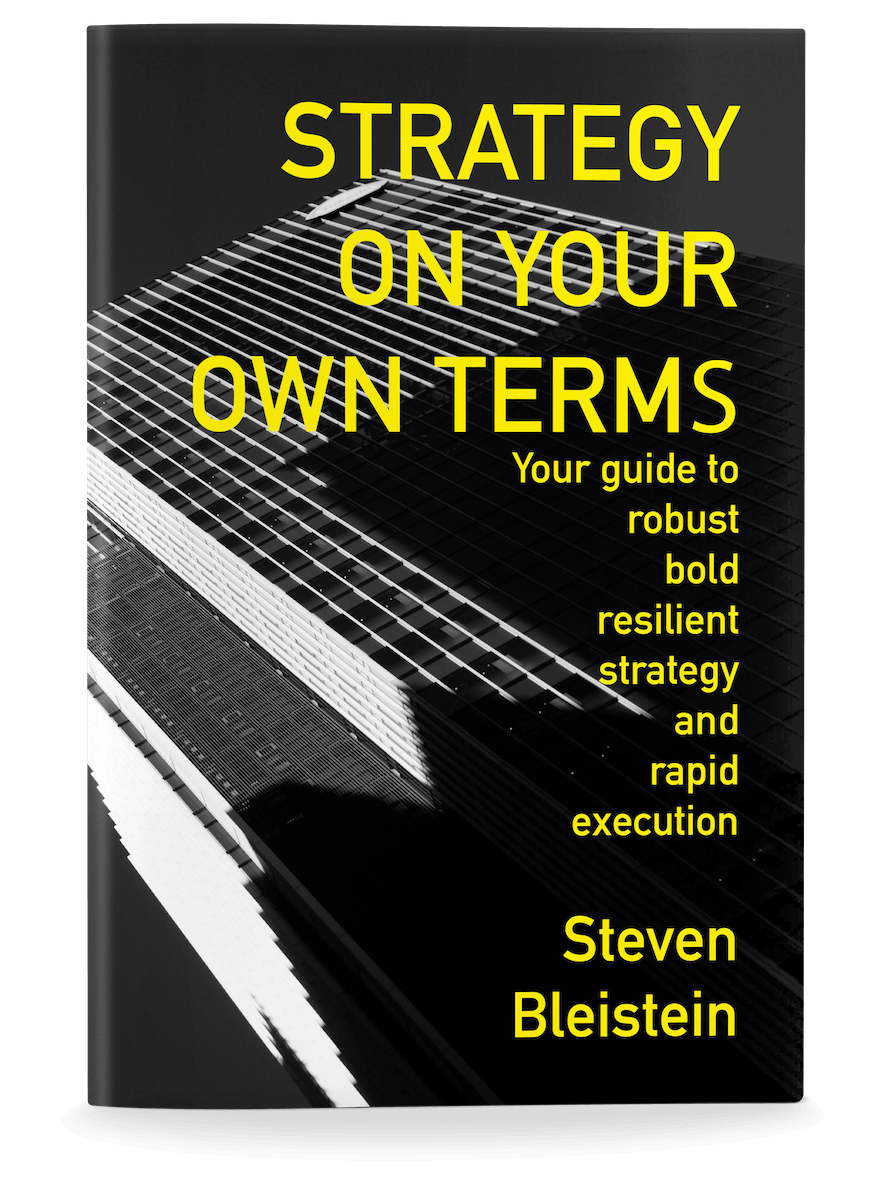
Steve’s New Book: Strategy on Your Own Terms
 English
  Japanese