

>> Click here to listen to this episode
Prefer to listen to the podcast version of this article? Click above to listen in on my Growth Zone podcast.
A technology company CEO I know recently told me a story I haven’t been able to stop thinking about.
His company was facing a crisis. Supply chain constraints — driven in large part by the AI-fueled explosion in chip demand — had caused component prices to triple. In some cases, product simply wasn’t available at any price. The problem was that his company had signed contracts with customers. Fixed prices. Delivery timelines. Penalty clauses for non-delivery. And now the entire basis of those contracts had been invalidated by the market.
Head office issued its missive: go to your customers and force through price increases. The contracts say what they say, but the business needs to protect its margins.
He spent a Friday running his entire team through role-played negotiation scenarios. Confrontational. Uncomfortable. Preparing for the worst. He went home that weekend and felt sick about it. Not because it was hard. Because it was wrong. Leadership is often the loneliest job in the world.
By Monday morning, he had made a decision. As his team was heading up in the elevator to face customers, he pulled them back. “We’re not going to negotiate with customers like we prepared,” he said. “There’s no time to explain. Just follow my lead.”
He sat down with each customer and told them exactly what was happening. Supply constrained. Prices tripled. Delivery in doubt. He acknowledged they had every right to pursue legal action for breach of contract. Then he asked a different question entirely: “Can we work together to reconfigure the products so we can still deliver on time and meet your requirements?”
Every single customer said yes.
His competitors took the other path — the legally defensible one. Many of them ended up in litigation. His customers still give him the order, even when his company isn’t the cheapest, even when the product isn’t the ideal choice, because the relationship survived the hardest moment it had ever faced. Never underestimate the value of trust.
I am seeing a version of this same challenge play out among many of the leaders I work with right now. Not in technology. In their own organizations.
The pattern is this: head office issues a directive. It makes business sense. The leader accepts it. But executing it means doing something that sits badly with who they are — their values and with the culture they have spent years building. An established tenant relationship that won’t be renewed because the space can be put to a more profitable use. A long-held operating model that engendered trust, dismantled in favor of a transactional one — relationships be damned. A people-first culture suddenly having to absorb a decidedly unsentimental set of new priorities, in which “people” becomes a value-signaling platitude and little more.
The tension these leaders feel is real. How they interpret it, however, is the difference between leaders who hold and leaders who fold.
Some leaders think the tension means the values have changed. They’re mistaken.
What has changed is the “what” — the strategic priorities, the business model, the direction from the top. The “how” is something else entirely. The how need not be dictated from head office. The how is always yours to decide.
Here is what I tell leaders in this situation.
The strategic direction may be non-negotiable. Accept that. Your job is not to relitigate the what. Your job is to insist — quietly, firmly, without apology — on your standards for how it gets executed.
That means you go to the people who will be affected and you tell them the truth, early, with as much runway as possible. You don’t hide behind the contract. You don’t delay the conversation because it’s uncomfortable. You don’t manage the optics and hope the situation resolves itself.
You treat people the way you’ve always treated them. That’s what values actually are — not what you say when things are easy, but what you do when the directive makes it hard.
The technology executive defied his head office. He had been told exactly what to do, and he did not do it. He did not ask for permission. He only informed his superiors after the fact. He made his decision, and resolved to deal with the consequences, come what may. But notice what he actually defied: not the strategic imperative to protect the business, but the method that would have destroyed something more valuable than the margin he was trying to protect. He found a way to serve both. He defied his superiors, and gave his customers news they likely did not want to hear. That is what dauntless leadership looks like.
The outcome for your people, your tenants, your partners may be the same regardless of how you handle it. Relationships end. Leases expire. Business models change. But how they end — whether people feel respected, dealt with honestly, given every possible chance to adapt — that is entirely within your control. And it is precisely there that your values either hold or they don’t.
Head office can change the what. You can decide the how. Choose wisely, and do so dauntlessly. After all, once you compromise your values, what else do you really have left?
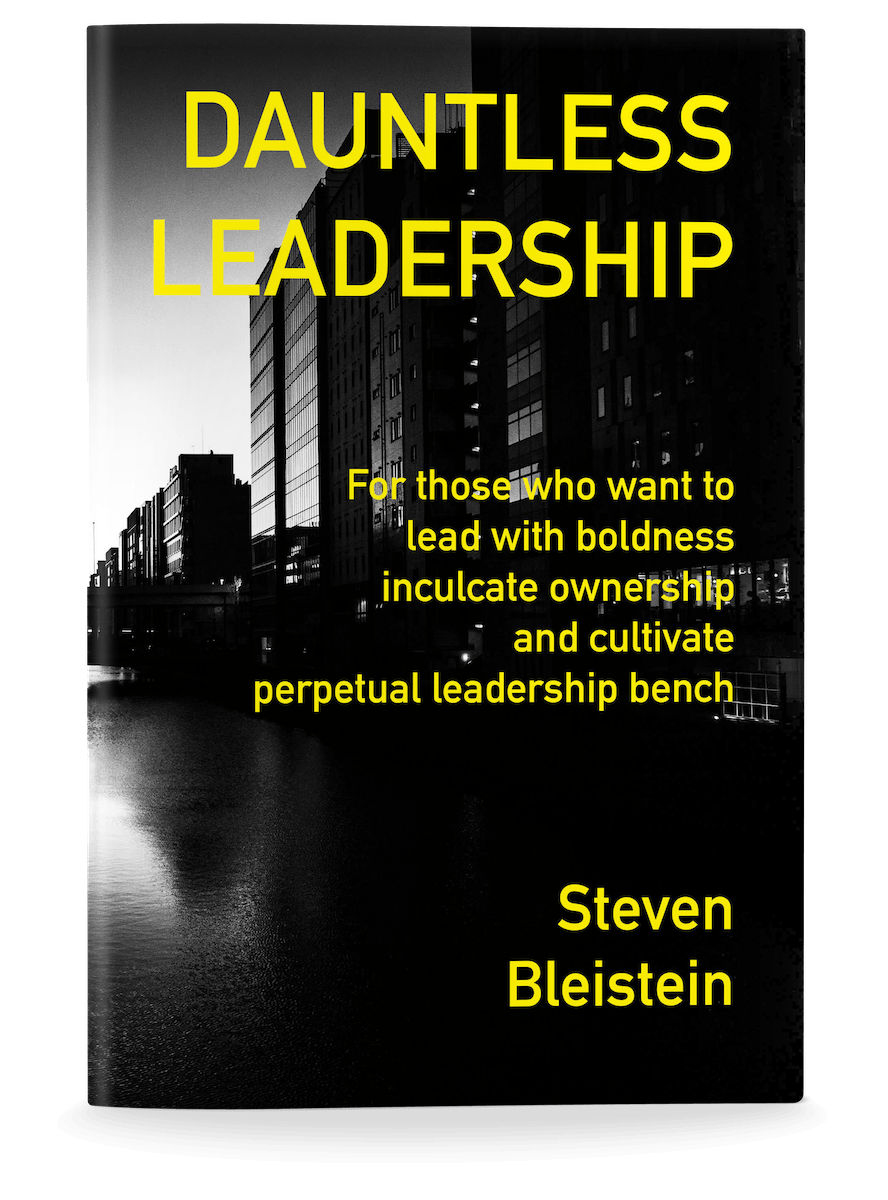
Steve’s New Book: Dauntless Leadership
 English
  Japanese