
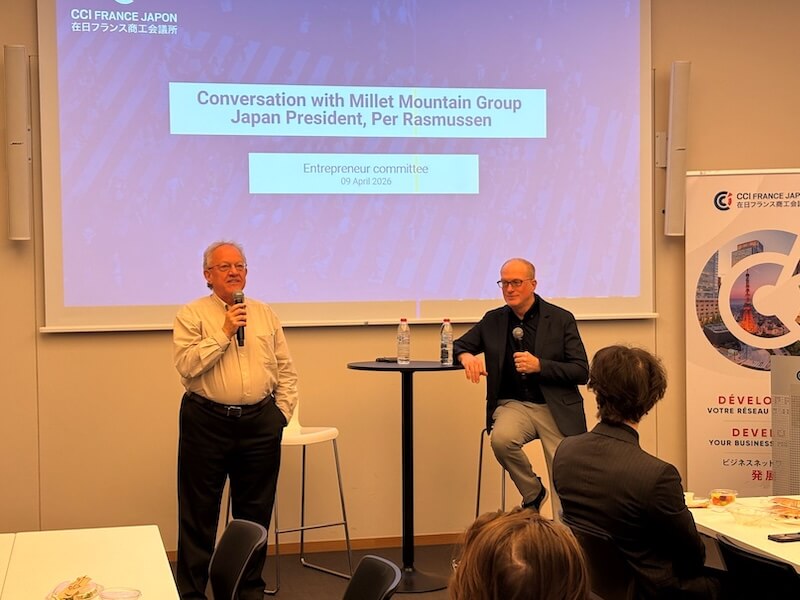
On April 9th, I had the honor of conducting an onstage conversation with Per Rasmussen, President and Representative Director of Millet Mountain Group Japan, for the French Chamber of Commerce in Japan. Six insights stood out.
1. A brand is not a logo.
Millet’s brand is built on an uncompromising commitment to technical performance — whether for vertical ascents above 3,000 meters or a half-day family hike in spring. That brand is earned through consumer experience, not manufactured through marketing. Placing a logo on a product and calling it a day is not Millet’s way. The products are fashionable, but fashion is not the point.
2. The Japanese market is not a smaller version of the European market.
Japanese mountaineering terrain, climate, and consumer behavior differ dramatically from those in France and the rest of Europe. Millet Japan innovates products specifically for Japanese conditions — and some of those products have since found their way back onto shelves in France. What makes a Millet product is not where it was made or who it was made for, but the DNA and philosophy embedded in its making.
3. Altitude is the ultimate proof of concept.
Above 3,000 meters, consumers consistently remark that Millet is virtually the only brand visible on the mountain. That is not a marketing claim. It is the outcome of a relentless focus on functionality where the stakes are highest–literally!
4. If you can’t own the store, own the floor.
The next best thing to having your own retail presence is having your own trained staff working within someone else’s store. For technical products, consumers often need expert guidance to understand what differentiates Millet from the competition. That expertise, placed at the point of purchase, is itself a competitive advantage.
5. The Japan leader’s most important role is translation — in every sense.
Leading a business in Japan frequently means serving as a bridge between head office expectations and the realities facing Japanese staff. The gap between the two is rarely just linguistic. Misalignment travels in both directions, and the leader’s job is to close it before it becomes costly.
6. Ignore the competition.
Analyzing competitors locks your business into a reactive posture. By the time you respond, they have already moved to their next position. Do what you do best, and be the best at it. The goal is to make competitors play in your sandbox — not the other way around.
 English
  Japanese