
[:en]The Anatomy of Misogyny[:ja]女性差別を分析すると[:]

[:en]The other week, Tokyo Medical University was revealed to have been deliberately boosting entrance test scores of male students to give them an advantage and to limit the number of female students since 2006. The motivation? Women shorten or halt their careers after becoming mothers, exacerbating staff shortage problems at hospitals. There is no real evidence for this, but whatever. Misogyny, like all other forms of hate, is always rationalized as being in some arbitrary best interest of the greater common good.
[:en]Blinkered by Targets[:ja]ターゲットばかりに固執することの危険性[:]

[:en]The best way to achieve performance targets is to ignore them. It’s improving performance form that counts.
[:en]Make Room For The Atheists[:ja]無神論者のための居場所も必要[:]

[:en] I despise the so-called evangelism that tends to accompany strategic change, particularly when the objective is to persuade people that the strategic direction that the business leaders have chosen is the righteous one to the exclusion of all others.
Labor Shortage is Never a Problem 労働力が不足していてもビジネスを成長させる方法

There are two ways to grow your business. You can do the same thing, only more of it. Or you can increase the value of what you do. At the time that I write this, Japan has an unemployment rate of less than three percent, so the latter is, for many businesses, the best viable option.
[:en]The Three Freedoms of Engagement[:ja]取り組みを促す3つの自由[:]

[:en]I don’t need to rely on the stock recommendations from prepackaged employee engagement surveys to gauge and improve a staff’s emotional commitment to the business, and neither do you. All I need to do is to gauge the degree of the three freedoms of employee engagement listed below, and that will tell me what I need to know.
[:en]Conversation with Visa Japan Country Manager Seiji Yasubuchi[:ja]ビザ・ジャパンのカントリーマネージャー、安渕聖司氏から学んだこと[:]
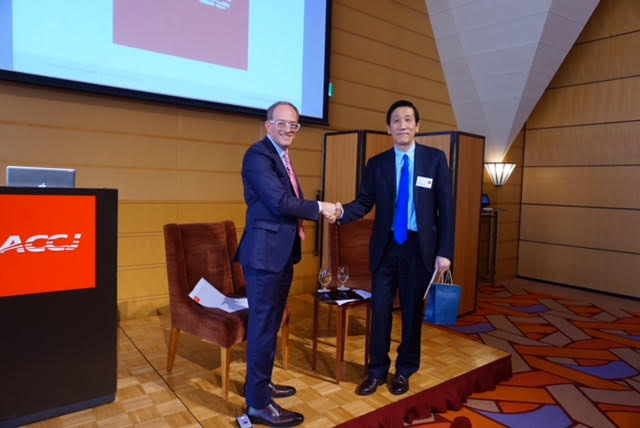
[:en]On April 3rd, I conducted an onstage conversation with Visa Japan Country Manager, Seiji Yasubuchi, at the Tokyo American Club for the American and French Chambers of Commerce in Japan. We had a full house! Here are my takeaways from my discussion with Seiji.
[:en]Growth is a State of Mind, Not a Market[:ja]企業の成長とは市場の状況ではなく、気持ちの持ち方によりもたらされるものである[:]

[:en]Return on investment of overseas acquisitions made by Japanese companies, with some exceptions, is feeble by large and at times disastrous.
Eschew the Putative Best People 「最高の人材」など存在しない

Your company should not have mass appeal as a great place to work, if it is exceptional people you want to attract.
[:en]Campaigns Don’t Shape Brands[:ja]ブランドとはキャンペーンによって形作られるものではない[:]

[:en]Campaigns don’t shape brands. Leaders do. Campaigns merely project to the outside world the brand as perceived by the people inside your company, whether that brand is how you like it or not. Dissonance will cause any branding campaign to fail, no matter what you do.
[:en]Japan’s Generous Paternity Leave[:ja]日本の育児休暇の実態[:]

[:en]When a new father asks for paternity leave, a manager can become defensive, even though paternity leave as stipulated by Japanese government regulation is one of the most generous in the world, with up to a year’s leave if desired. Government regulation has achieved nothing in terms of healthy work style behaviors because regulation is not the root cause of excesses. Whether excessive overtime or forgoing paternity leave, the root cause is never because of government regulation or company policy. The root cause is always a deficit of leadership capability.
 Japanese
  English