
[:en]AI-Induced Atrophy[:ja]人工知能がもたらす退化[:]

[:en]For some, artificial intelligence and automation in business herald a new era of increased productivity. For others, these are a harbinger of job obsolescence and layoffs.
[:en]Culture Change Manifesto[:ja]企業改革宣言[:]

[:en]I define culture as norms of behaviors based on shared beliefs. When a leader says he or she wants to change the culture of his or her company, the ultimate goal is always to change norms of behaviors. If I want to understand the culture of a company, all I need to do is observe which behaviors are encouraged and rewarded, which are discouraged and penalized, and which are the behaviors to which people are indifferent. I can understand the beliefs that drive those behaviors by asking questions.
[:en]No More New Strategy Tools[:ja]戦略ツールなどいらない[:]

[:en]In photography, new cameras do not make for better art, just as in strategy, new tools do not make for better business results.
[:en]Could You Get a Job at Your Own Company?[:ja]自分の会社に採用してもらえるかどうか[:]

[:en]If you are finding it difficult to fill key roles with excellent people, don’t assume it is because your company does not attract the right candidates, but rather that the right candidates don’t get through your company’s screening process. If you applied for a job at your own company, you too might not get through either.
[:en]Ideology is No Ersatz for Strategy[:ja]イデオロギーは戦略の代わりになり得るものではない[:]

[:en] A friend of mine recently observed that Japanese Prime Minister Shinzo Abe’s strategy to deter a Chinese seizure of the disputed Senkaku Islands makes no sense.
[:en]No Path to Excellence in Market Price[:ja]市場価格にこだわらないこと[:]

[:en] Saving pennies should never justify forgoing dollars of income. The most successful business people I know never consider cost, and only consider ROI, particularly when hiring people and engaging services. There is no path to excellence through paying market price. A consistent ROI focus results in rapid growth and success.
[:en]Make Your Own Economy[:ja]景気は自分で作り出すもの[:]

[:en]Are you allowing the economy to dictate your results, or are you making your own economy? In 1995, in the aftermath of the Kobe earthquake in which five thousand people lost their lives, an American businessman told me that he had been advised to lower his expectations for the Japan market because Japanese consumers had reduced their spending, so as not to appear ostentatious or feel guilty about enjoying life in the wake of the tragedy suffered by their compatriots.
[:en]Conversation with IHG/ANA Hotels CEO Hans Heijligers[:ja]IHG・ANAホテルズCEOハンス・ハイリガーズ氏から学んだこと[:]
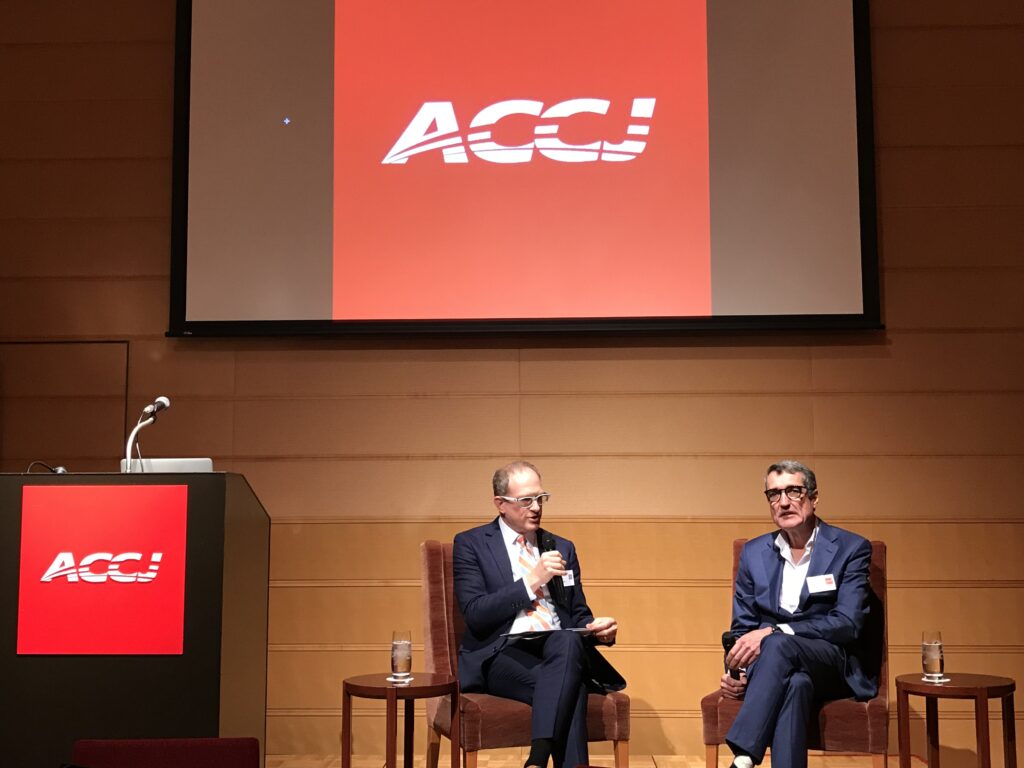
[:en]On June 25th, I conducted an on-stage conversation with IHG/ANA Hotels Group Japan CEO, Hans Heijligers for both the American and French Chambers of Commerce at the Tokyo American Club. Here are my takeaways from that conversation.
[:en]Change Discipline, Not Management[:]

[:en]The currency of discipline is choice, and that choice is yours to make. Change management is ostensibly a practice to help people in an organization make a transition as a result of a disruptive organization change. However, disruption need not be disruptive if disruption is part of your discipline.
[:en]The Seller is God[:ja]売り手は神である[:]

[:en]When a salesperson tells me, “The way to make a customer happy is to treat them as God!” usually he or she means acquiescing to and fulfilling every demand and whim. Nothing could be further from the truth. No, the customer is not God, nor does the customer ever really want to be. Rather, it is the salesperson that can be a god to the customer if he or she does things right.
 Japanese
  English